Technical Overview
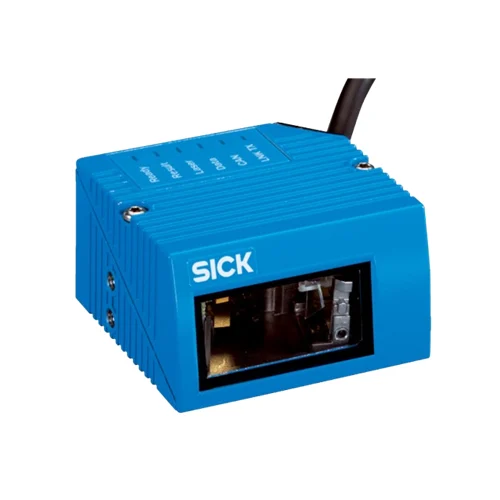
The SICK CLV621-0000 is a Long Range fixed-mount 1D barcode scanner with a front reading field and fixed optical focus. Its visible 655 nm Class 2 laser scans at 400–1,200 Hz, with a specified 60–730 mm reading envelope that depends on code resolution and position in the reading-field diagram. It supports 0.35–1 mm code resolution, multiple-code reading and serial, CAN and CANopen communication. PROFINET, EtherCAT and PROFIBUS DP integration use the specified optional external fieldbus modules. The device connects through a 0.9 m cable ending in a 15-pin D-Sub HD male plug. An IP65 die-cast aluminum housing, glass window, M5 mounting, configurable result buzzer and six indicators support installation and commissioning.
Long Range front-reading 1D laser scanner with fixed focus, 60–730 mm resolution-dependent reading envelope, serial/CAN interfaces and 15-pin cable connection.
Key Features
- Long Range 1D barcode scanner; front reading field; fixed focus
- 655 nm visible red Class 2 laser; aperture angle ≤50°
- 60–730 mm reading envelope subject to code-resolution reading-field diagram
- 400–1,200 Hz scanning; 0.35–1 mm code resolution
- Standard decoder: 1–20 codes per scan; SMART620: 1–6
- RS-232/RS-422/RS-485, CAN and CANopen communication
- Optional external modules for PROFINET, EtherCAT and PROFIBUS DP
- 0.9 m cable with 15-pin D-Sub HD male connector
- 10–30 V DC; 4.5 W; IP65 die-cast aluminum housing and glass window
- SOPAS ET configuration; six LEDs and configurable result buzzer
Read printed 1D codes with a fixed-focus front scan line and transfer decoded data through serial or CAN connections for external identification control.
Technical Specification Matrix
| Parameter | Value |
|---|
| Functional principle | Laser-based reading of printed 1D barcodes |
| Version | Long Range |
| Scanner type | Line scanner; front reading field |
| Optical focus | Fixed focus |
| Light source | Visible red laser; 655 nm |
| Laser class | Class 2; EN 60825-1:2014+A11:2021 and IEC 60825-1:2014; 21 CFR 1040.10 with Laser Notice No. 56 conformance exception |
| Aperture angle | ≤50° |
| Reading distance | 60–730 mm; depends on code resolution and position within manufacturer reading-field diagram |
| Scanning frequency | 400–1,200 Hz |
| Code resolution | 0.35–1 mm |
| Barcode types | Code 39; Code 128; Code 93; Codabar; GS1-128/EAN 128; UPC/GTIN/EAN; Interleaved 2 of 5; Pharmacode; GS1 DataBar; Telepen; MSI/Plessey |
| Print ratio | 2:1–3:1 |
| Codes per scan | 1–20 standard decoder; 1–6 SMART620 |
| Codes per reading interval | 1–50; auto-discriminating |
| Characters per reading interval | 1,500; 500 for multiplexer function in CAN operation |
| Multiple readings | 1–99 |
| Serial interface | RS-232; RS-422; RS-485; read-result data interface and service interface |
| Serial transmission rate | 2,400 baud–115.2 kbaud; AUX RS-232 57.6 kbaud |
| CAN interface | SICK CAN sensor network CSN; controller/device and multiplexer/server; 20 kbit/s–1 Mbit/s |
| CANopen | 20 kbit/s–1 Mbit/s |
| PROFINET integration | Optional external CDF600-2 fieldbus module; Single Port or Dual Port |
| EtherCAT integration | Optional external CDF600 fieldbus module |
| PROFIBUS DP integration | Optional external CDF600-2 fieldbus module |
| Digital inputs | Sensor 1 and Sensor 2; two additional inputs via optional CMC600 in CDB620/CDM420 |
| Digital outputs | Result 1 and Result 2; two additional outputs via optional CMC600 in CDB620/CDM420 |
| Reading pulse | Digital inputs; non-powered; serial interface; auto pulse; CAN |
| Optical indication | Six LEDs: Ready, Result, laser, Data, CAN, LNK TX |
| Acoustic indication | Beeper/buzzer; can be disabled or allocated to result indication |
| Configuration software | SOPAS ET |
| Connection | 0.9 m cable with one 15-pin D-Sub HD male connector |
| Power supply | 10–30 V DC |
| Power consumption | 4.5 W |
| Protection class | III; VDE 0106/IEC 1010-1 |
| Housing material | Die-cast aluminum; light blue RAL 5012 |
| Window material | Glass |
| Mounting | M5 threaded holes |
| IP rating | IP65; DIN 40 050 |
| MTBF | 100,000 h |
| Laser diode MTTF | 40,000 h at +25 °C |
| EMC | EN 61000-6-3 (2001-10) / EN 61000-6-2:2005 |
| Vibration resistance | EN 60068-2-6 (1995) |
| Shock resistance | EN 60068-2-27 (1993) |
| Operating temperature | 0 to +40 °C |
| Storage temperature | −20 to +70 °C |
| Relative humidity | 90%; non-condensing |
| Ambient light immunity | 2,000 lx on barcode |
| Barcode print contrast PCS | ≥60% |
| Physical Weight (kg) | 0.225 |
Industrial Applications
1. Routing labeled cartons at a conveyor decision point
A conveyor can present a carton’s printed 1D label across the scanner’s front scan line and send its decoded identifier to external routing logic. The controller associates that identifier with a downstream diverter command. Mechanical design holds label orientation and distance within the reading field for the actual code resolution, with scan frequency chosen for the presentation interval.
Problem Solved
Decoded carton identifiers give external routing control a destination reference, helping assign each presented load to its configured conveyor path based on its printed barcode.
Carton routing
Printed 1D label
Serial/CAN
2. Checking a presented label against the production order
A packing station can trigger a reading interval when a labeled item reaches a defined fixture position. External inspection logic compares the decoded 1D identifier with the active production order and records a match or mismatch. The setup uses a supported symbology, at least 60% print contrast and the corresponding resolution-dependent reading field; result indication assists operator setup.
Problem Solved
A decoded label value gives external order-checking logic a direct comparison reference, helping identify an item carrying a code that differs from the active packing order.
Order verification
Triggered reading
Result indication
3. Recording multiple codes on a grouped package
A grouped package with several presented 1D labels can cross the scan line during one externally managed reading interval. The standard decoder supports up to 20 codes per scan and up to 50 auto-discriminated codes per interval. External tracking software associates the returned code set with the package event, using an arranged label layout that crosses the line and stays within the reading field.
Problem Solved
Multiple decoded codes within a reading interval give external tracking software a grouped identification record, helping associate several presented labels with the same package event.
Grouped identification
Multiple codes
External tracking