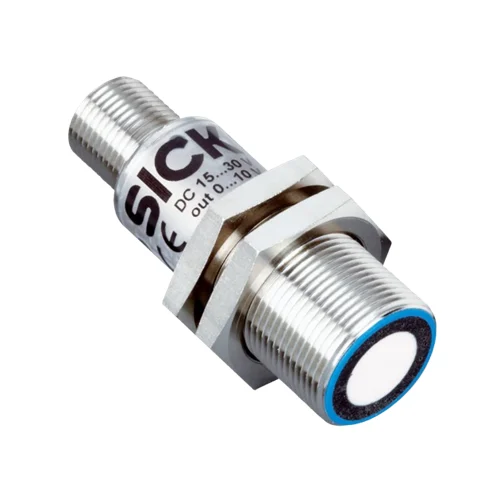
SICK 6048404 UM18-218126111 4–20 mA Ultrasonic Distance Sensor

USD 390.26

UM18-218126111 measures 120–1,000 mm with a teachable 4–20 mA output, 12-bit analog resolution, temperature compensation and M12 five-pin connection.

SKU SICK-6048404 Category
Ultrasonic Distance Sensors - SICK UM18

SICK UM18-218126111 4–20 mA Ultrasonic Distance Sensor

BrandSICK
Model IdentifierUM18-218126111
Official Part Number6048404

Technical Overview

The SICK UM18-218126111 is a straight-axis M18 ultrasonic distance sensor with a 120–1,000 mm operating range and separate 1,300 mm limiting range. Its typical 200 kHz transducer provides distance feedback through one teachable, invertible 4–20 mA output with 12-bit analog resolution. Temperature compensation supports the specified ±1% measurement accuracy, referenced to the current reading, while target reflectivity, size and alignment determine the detection area. Response is 80 ms with a 20 ms output time; subsequent analog smoothing can increase response time. An M12 five-pin plug connects supply, analog signal and multifunction input for teaching, synchronization or multiplexing. The nickel-plated brass housing provides IP65/IP67 protection and green/orange indication on a 10–30 V DC supply.

Straight M18 ultrasonic sensor with 120–1,000 mm operating range, teachable 4–20 mA output, temperature compensation and M12 five-pin plug.

Key Features

  • 120–1,000 mm operating range; 1,300 mm limiting range
  • Typical ultrasonic frequency 200 kHz; straight sending axis
  • Resolution ≥0.069 mm; ±0.15% repeatability subject to stated conditions
  • ±1% measurement accuracy relative to current reading; temperature compensation
  • One teachable, invertible 4–20 mA output; 12-bit analog resolution
  • Load ≤500 Ω; at supply ≤20 V, load limited to ≤100 Ω
  • 80 ms response; 20 ms output time; analog smoothing can increase response
  • Multifunction input for external teach, synchronization and multiplexing
  • M18 × 1 nickel-plated brass housing; M12 five-pin plug; IP65/IP67
  • 10–30 V DC; ≤1.2 W without load; −25 to +70 °C operation

Teach the analog distance span and supply a 4–20 mA position signal to external process control within the verified ultrasonic operating range.

Technical Specification Matrix

ParameterValue
Functional principleUltrasonic distance measurement
Operating range120–1,000 mm
Limiting range1,300 mm
Detection-area conditionsRange depends on object reflection properties, size and alignment; diagram examples use aligned 500 × 500 mm plate and Ø27 mm pipe
Resolution≥0.069 mm
Repeatability±0.15% of current measured value; minimum value ≥resolution
Measurement accuracy±1% of current measured value
Temperature compensationProvided; can be disabled; uncompensated drift 0.17%/K
Response time80 ms; subsequent analog smoothing may increase response time by up to 200%, depending on application
Output time20 ms
Typical ultrasonic frequency200 kHz
Analog outputOne 4–20 mA current output; teachable and invertible; 12-bit resolution
Analog load≤500 Ω; when supply ≤20 V, maximum load ≤100 Ω
Multifunction inputOne MF: external teach, synchronization, multiplexing; Connect+ communication shown in connection diagram
SynchronizationUp to 20 sensors, as specified in current exact datasheet
MultiplexingUp to 20 sensors without cross talk under configured multiplex operation
ResetFactory-default reset supported
Power supply10–30 V DC; reverse-polarity protected; Class 2 short-circuit-protected network, maximum 8 A
Power consumption≤1.2 W without load
Initialization time<300 ms
IndicationTwo LEDs: green supply, orange switching/analog output
Protection classIII
Housing designCylindrical; straight sending axis
Mounting threadM18 × 1
Housing materialNickel-plated brass; transducer polyurethane foam and glass epoxy resin
Mounting detailFixing nuts, 24 mm across flats; drawing axial length 52.7 mm
ConnectionM12 five-pin male connector
Pin assignment1 BN=L+; 2 WH=QA; 3 BU=M; 4 BK=not assigned; 5 GY=MF
IP ratingIP65 / IP67
Operating temperature−25 to +70 °C
Storage temperature−40 to +85 °C
MTTFD101 years
DCavg0%
Physical Weight (kg)0.025

Industrial Applications

1. Monitoring the diameter of a wound material roll

A winding station can aim the ultrasonic axis at the roll surface and feed the 4–20 mA signal into external diameter-calculation logic. The controller converts the taught distance span using the installed geometry. Setup keeps the surface within 120–1,000 mm, verifies the actual target response and selects control timing using the 80 ms response and any configured analog smoothing.

Problem Solved

A taught surface-distance signal gives external winding control a roll-size reference, helping track changing material diameter as the roll builds or unwinds.

Roll diameter 4–20 mA External calculation

2. Measuring the position of a slowly moving panel

A handling fixture can present a sufficiently reflective panel along the straight ultrasonic axis and send its distance value to an external analog input. The taught output span maps the required travel interval to 4–20 mA. Commissioning assesses panel size and alignment, the ±1% accuracy relative to the current reading, and the analog-input load at the selected supply voltage.

Problem Solved

An analog distance value gives external handling control a panel-position reference, helping monitor slow travel relative to the installed sensor without mechanical contact.

Panel position Taught span Analog load

3. Coordinating adjacent ultrasonic measurement points

A machine with adjacent compatible measurement points can use the multifunction inputs for configured synchronization or multiplexing. The current exact datasheet supports up to 20 sensors and describes multiplexing without mutual cross talk. External acquisition schedules each 4–20 mA observation for the chosen operating arrangement, accounting for the output time and application-dependent analog smoothing.

Problem Solved

Coordinated ultrasonic operation separates neighboring measurement activity, helping external acquisition obtain distance signals from several configured sensing points with reduced mutual acoustic interference.

Adjacent sensors Synchronization Multiplexing

Select your currency