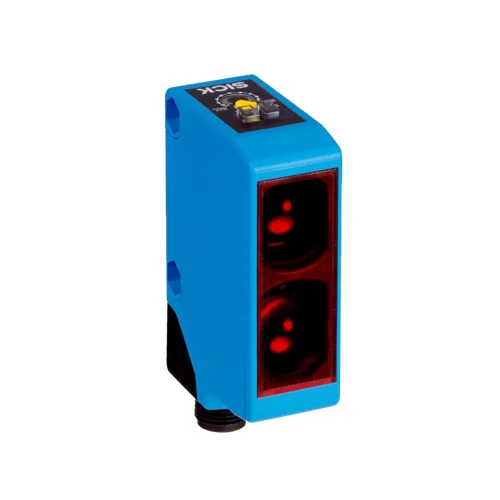
1. Counting separated cartons before a farther background
A conveyor can present separated cartons inside the adjusted sensing boundary while a farther machine surface remains outside it. The two-turn potentiometer establishes the background-suppression setting using representative targets. External counting logic evaluates the PNP transitions, with commissioning checking actual target remission, carton spacing and speed against the 3 ms response and 160 Hz switching specifications.
Problem Solved
A reflected-light passage reference helps external counting logic track separated cartons from one mounting side, with the adjusted boundary verified against the actual carton and background surfaces.
Carton counting
Background suppression
PNP output
2. Checking a load on a presented carrier
A handling station can present a carrier so its expected load lies within the sensing region and the empty carrier or background lies farther away. Representative loaded and empty carriers establish the potentiometer setting. External inspection samples the PNP state after presentation and selects light/dark behavior through the L/D connection, with darker target limits and position tolerance checked during setup.
Problem Solved
A load-present reference helps external inspection distinguish a loaded carrier from an empty presentation, supporting an omitted-load check after the actual geometry and target surfaces are commissioned.
Carrier inspection
Load presence
L/D selection
3. Timing a load that remains at a transfer stop
A conveyor transfer can position a load surface within the adjusted sensing region at its receiving stop. External sequencing times the resulting PNP condition and compares it with normal passage duration to identify sustained occupancy. The yellow received-light and green stability indicators support local setup, while the rotatable M12 connector allows the selected cable exit to suit the mounting space.
Problem Solved
Timing the occupied condition gives external transfer control a basis for recognizing a load that remains at the stop, helping coordinate subsequent release with the downstream process.
Transfer occupancy
External timing
Local indication