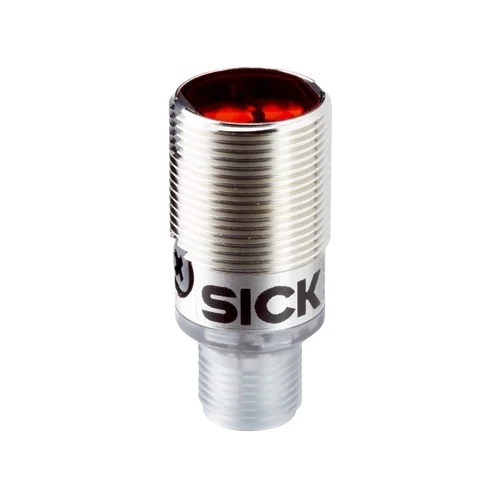
SICK 1058204 GRTE18S-P2312 M18 PNP Diffuse Photoelectric Sensor

USD 49.14

GRTE18S-P2312 offers 5–100 mm reference-white diffuse sensing, a 650 nm PinPoint LED, PNP light switching, 270° adjustment and M12 three-pin connection.

SKU SICK-1058204 Category
SICK GR18S

SICK GRTE18S-P2312 M18 PNP Diffuse Photoelectric Sensor

BrandSICK
Model IdentifierGRTE18S-P2312
Official Part Number1058204

Technical Overview

The SICK GRTE18S-P2312 is an axial M18 × 1 energetic photoelectric proximity sensor with a PNP light-switching output. Its 5–100 mm sensing range and 3–115 mm maximum range apply to 90% remission reference white. A 650 nm PinPoint LED forms an 8 mm spot at 100 mm, and a 270° potentiometer adjusts the sensing condition. The response is below 1,000 µs with resistive load, with 500 Hz switching at a 1:1 light/dark ratio. The IP67 nickel-plated brass/ABS housing has PMMA optics and an M12 three-pin connector. Output current and ambient-temperature ratings have supply-dependent limits; −25 to +55 °C operation requires supply ≤24 V and output current <50 mA.

Axial M18 energetic sensor with 5–100 mm reference-white range, PNP light switching, 650 nm PinPoint LED and M12 three-pin connection.

Key Features

  • Axial energetic photoelectric proximity sensing in an M18 × 1 housing
  • 5–100 mm sensing; 3–115 mm maximum on 90% remission white
  • 650 nm red PinPoint LED; Ø8 mm spot at 100 mm
  • 270° potentiometer adjusts sensing range
  • Single PNP light-switching output
  • Response <1,000 µs with resistive load; 500 Hz at 1:1 light/dark ratio
  • 10–30 V DC; output ≤100 mA, reduced to 50 mA above 24 V or above +49 °C
  • M12 three-pin connector; green power and yellow target LEDs
  • Nickel-plated brass/ABS housing; PMMA optics; IP67
  • Two metal mounting nuts; −25 to +55 °C at supply ≤24 V and output <50 mA

Adjust reflected-light sensing locally in a short M18 body and transmit a PNP target event through the three-pin M12 connector.

Technical Specification Matrix

ParameterValue
Functional principleEnergetic photoelectric proximity sensor
Housing designCylindrical; axial optical axis
Mounting threadM18 × 1
Sensing range5–100 mm on 90% remission reference white, DIN 5033
Maximum sensing range3–115 mm on 90% remission reference white, DIN 5033
Secondary target ranges20% gray: sensing 10–70 mm, maximum 5–85 mm; 6% black: sensing 15–50 mm, maximum 10–60 mm
Light sourceVisible red PinPoint LED; 650 nm
Average LED service life100,000 h at +25 °C
Light spot sizeØ8 mm at 100 mm
AdjustmentSensing-range potentiometer, 270°
Switching outputSingle PNP output
Switching modeLight switching
PNP signal voltageHIGH: supply voltage minus a drop ≤3 V; LOW approximately 0 V
Output current≤100 mA; maximum 50 mA when supply >24 V or ambient temperature >49 °C
Response time<1,000 µs signal transit time with resistive load
Switching frequency500 Hz at 1:1 light/dark ratio
ConnectionM12 three-pin connector
Pin assignmentCD-045: 1 BN=L+; 3 BU=M; 4 BK=Q
Power supply10–30 V DC; short-circuit-protected supply network, maximum 8 A
Ripple<5 Vpp; remain within supply-voltage tolerances
Current consumption30 mA
Circuit protectionSupply and input/output reverse-polarity protection; output overcurrent and short-circuit protection
Protection classIII
Housing materialNickel-plated brass and ABS
Optics materialPMMA plastic
IP ratingIP67
Items suppliedTwo metal fastening nuts, 24 mm across flats
Housing axial length38.1 mm, including integral M12 connector
IndicationGreen LED on: power on; yellow LED on: object present; yellow off: object absent
EMCEN 60947-5-2
Operating temperature−25 to +55 °C at supply ≤24 V and output current <50 mA
Storage temperature−40 to +70 °C
UL fileNRKH.E348498 and NRKH7.E348498
MTTFD1,632 years
DCavg0%
Mission time20 years

Industrial Applications

1. Confirming a component at a short-range assembly point

An assembly station can present an opaque component within the adjusted sensing zone and read the PNP light-switching event. The axial M18 mounting and local potentiometer support alignment beside the fixture. Commissioning checks actual target remission and distance against the appropriate range, while electrical loading follows the supply and ambient-temperature derating conditions.

Problem Solved

A reflected-light event helps external assembly logic confirm component presentation from one mounting side, using the installed target surface and adjusted sensing distance as its detection basis.

Component presentation Axial M18 PNP event

2. Counting separated objects along a guided feed

A guided feed can pass separated opaque objects across the sensing point and send PNP transitions to an external counter. The 500 Hz rating and response below 1,000 µs establish the timing basis. Setup checks target coverage of the light spot, actual remission, travel speed and spacing so each object produces a distinct event.

Problem Solved

Distinct reflected-light transitions give external counting logic passage events for separated objects, helping track feed quantity at a fixed sensing point without a separate receiver.

Object count 500 Hz Reflected-light passage

3. Identifying an interrupted material-presence condition

A material-handling station can aim the sensor at an opaque strip or sheet that normally occupies a defined location. External logic observes loss of the PNP light-switching condition when a break or exhausted feed removes the material. Commissioning checks remission, surrounding surfaces and adjusted range so the material-present and material-absent states remain distinguishable.

Problem Solved

Loss of the established reflected-light condition helps external feed monitoring recognize missing material, allowing its process sequence to respond before continuing with an empty presentation point.

Material presence Feed interruption Light switching

Select your currency