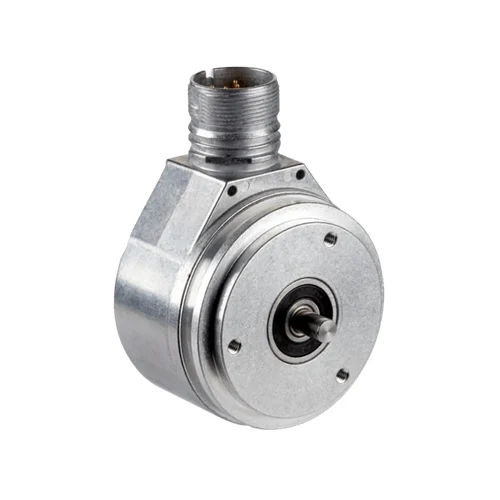
1. Measuring travel through a driven feed shaft
A material feeder can mechanically couple the encoder to its drive shaft and evaluate A/B transitions with an external counter. The controller converts incremental revolutions into travel using the installed drive ratio and 1,024 pulses per revolution. Commissioning checks slip, coupling alignment and electrical input compatibility before using the counts as a feed-distance reference.
Problem Solved
Incremental shaft feedback gives external feed-control logic a travel reference related to the installed drive geometry, helping track material advance through the selected mechanical ratio.
Feed travel
1,024 PPR
A/B transitions
2. Monitoring shaft speed from incremental pulse timing
A drive-monitoring controller can calculate rotational speed from incremental pulse frequency and the known 1,024 pulses per revolution. The HTL push-pull interface connects to a compatible counting input. Setup checks input frequency capability and the separate electrical and mechanical encoder limits, including speed-related self-heating, before comparing measured speed with the expected operating pattern.
Problem Solved
Frequency-derived rotational feedback helps external monitoring identify changes in drive behavior, using the known pulse count and compatible input timing as its calculation basis.
Speed monitoring
HTL push-pull
Pulse frequency
3. Referencing a repeating rotary-machine cycle
A rotary machine can use the encoder Z signal as a repeating reference alongside incremental A/B counts. One index signal per revolution is logically gated with A and B at 90° electrical. External sequencing establishes the installed relationship between that reference and the machine tooling so it can relate counted movement to the intended cycle.
Problem Solved
A once-per-revolution index provides external sequencing with a recurring rotational reference, helping relate incremental counts to the selected tooling cycle after the mechanical setup is established.
Index reference
Rotary cycle
A/B gating