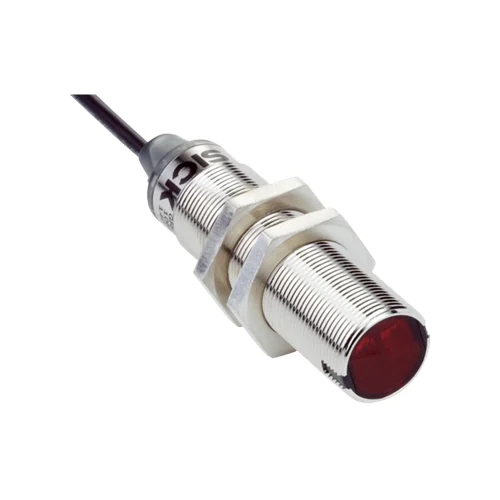
SICK 1067984 GRSE18-P1142 PNP Through-Beam Sensor Pair

USD 87.62

GRSE18-P1142 combines a red-light sender and PNP complementary receiver, 0–10 m sensing, 270° sensitivity adjustment, sender test input and 2 m cables.

SKU SICK-1067984 Category
SICK GR18

SICK GRSE18-P1142 PNP Through-Beam Sensor Pair

BrandSICK
Model IdentifierGRSE18-P1142
Official Part Number1067984

Technical Overview

The SICK GRSE18-P1142 is a through-beam photoelectric sensor pair combining the GRS18-D1341 sender and GRE18-P1132 receiver. Its axial 650 nm red PinPoint LED beam has a specified 0–10 m sensing range and 0–15 m maximum range. The receiver provides complementary PNP light/dark outputs, with response below 500 µs under resistive load and 1,000 Hz switching at a 1:1 light/dark ratio. A 270° potentiometer adjusts sensitivity, while driving the sender Test input to 0 V switches off emission for external checks. The M18 × 1 nickel-plated brass/ABS housings use PMMA optics, 2 m PVC cables and IP67 protection; output current and operating-temperature ratings have supply-dependent conditions.

M18 red-light through-beam sender/receiver pair with 0–10 m sensing, complementary PNP outputs, sender Test input and 2 m PVC cables.

Key Features

  • Through-beam pair: GRS18-D1341 sender, 2072235; GRE18-P1132 receiver, 2073765
  • 0–10 m sensing range; 0–15 m maximum range
  • 650 nm red PinPoint LED; Ø250 mm beam at 10 m
  • Axial optical axis; M18 × 1 cylindrical housings
  • Complementary PNP light/dark outputs; <500 µs resistive-load response
  • 1,000 Hz switching at 1:1 light/dark ratio; 270° sensitivity potentiometer
  • Sender OFF when Test input is at 0 V
  • 10–30 V DC; ≤100 mA output, reduced to 50 mA above 24 V or above +49 °C
  • 2 m four-wire PVC cable connection; do not bend below 0 °C
  • Nickel-plated brass/ABS housings, PMMA optics and IP67; four fastening nuts supplied

Use an opposed red-light sender and complementary PNP receiver to report beam interruption, with a sender test input for commanded optical checks.

Technical Specification Matrix

ParameterValue
Functional principleThrough-beam photoelectric sensor; sender and receiver pair
Individual components2072235 GRS18-D1341 sender; 2073765 GRE18-P1132 receiver
Housing designCylindrical; axial optical axis; M18 × 1 thread
Sensing range0–10 m
Maximum sensing range0–15 m
Light source650 nm visible red PinPoint LED
Average LED service life100,000 h at +25 °C
Light spot sizeØ250 mm at 10 m
Adjustment270° sensitivity potentiometer
Green indicatorPower on when lit
Yellow indicatorReceived beam: lit when object absent; off when object present
Power supply10–30 V DC; short-circuit-protected network, maximum 8 A
Ripple<5 Vpp; remain within supply tolerances
Current consumption30 mA
Switching outputPNP
Output functionComplementary
Switching modeLight/dark switching
PNP signal voltage HIGH/LOWSupply voltage −(≤3 V) / approximately 0 V
Output current≤100 mA; maximum 50 mA at supply >24 V or ambient >+49 °C
Response time<500 µs; signal transit time with resistive load
Switching frequency1,000 Hz at 1:1 light/dark ratio
Connection2 m four-wire PVC cable; do not bend below 0 °C
Connection assignmentCD-088: sender BN=L+, BU=M, BK=Test, WH=not connected; receiver BN=L+, BU=M, BK=Q, WH=inverted Q
Test inputSender OFF at Test=0 V
Circuit protectionSupply connections reverse-polarity protected; inputs/output reverse-polarity protected; outputs overcurrent and short-circuit protected
Protection classIII
Housing materialNickel-plated brass and ABS
Optics materialPMMA
IP ratingIP67
Items suppliedFour fastening nuts; two per unit, 24 mm across flats
EMCEN 60947-5-2
Operating temperature−25 to +55 °C at supply ≤24 V and output current <50 mA
Storage temperature−40 to +70 °C
UL fileE348498

Industrial Applications

1. Counting separated opaque cartons across a conveyor

A conveyor can mount the sender and receiver opposite one another so each separated opaque carton interrupts their optical path. The PNP complementary outputs provide opposite signal states to external counting inputs. The 0–10 m sensing range accommodates the installed separation, while response below 500 µs supports distinct edges when carton spacing and controller sampling are suitable.

Problem Solved

Beam interruption gives external counting logic a passage event without relying on light reflected from the carton surface, helping track separated loads across the conveyor.

Through-beam counting PNP complementary <500 µs

2. Monitoring continuity of an opaque material feed

An opaque sheet feeder can place the beam through the material path so normal material blocks reception. A break or exhausted supply opens that path and changes the receiver outputs. A 270° potentiometer adjusts sensitivity for the installed separation, and complementary PNP signals let external monitoring use the appropriate polarity for the material-present state.

Problem Solved

A persistent received-light change gives external feed monitoring a material-continuity event, helping identify a broken or exhausted opaque feed before subsequent processing proceeds.

Material continuity 270° sensitivity Complementary states

3. Checking an optical channel through the sender test input

Between production cycles, external diagnostic logic can drive the sender Test input to 0 V to switch off its light. The receiver then changes its complementary outputs as the beam disappears. The controller compares the commanded test interval with the observed states, using compatible timing and a clear optical path before restoring normal process monitoring.

Problem Solved

A commanded sender-off interval provides an intentional optical-state change for external diagnostic logic, helping distinguish an expected receiver response from an unchanged process input.

Sender test External diagnosis Optical-state change

Select your currency