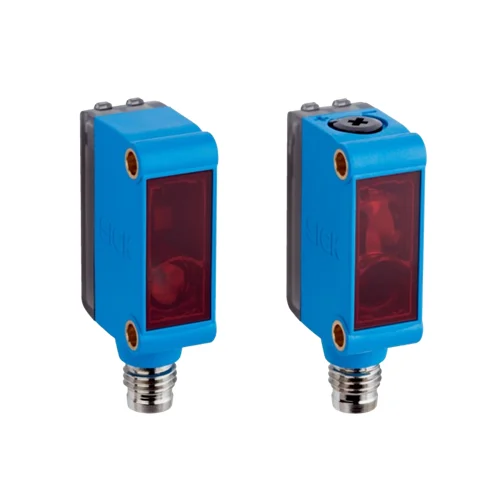
SICK 1061396 GSE6-P4212 PNP Through-Beam Sensor Pair

USD 91.26

GSE6-P4212 provides 0–10 m through-beam sensing, red PinPoint LED light, PNP light/dark selection and M8 four-pin connectors; two brackets supplied.

SKU SICK-1061396 Category
SICK G6

SICK GSE6-P4212 PNP Through-Beam Sensor Pair

BrandSICK
Model IdentifierGSE6-P4212
Official Part Number1061396

Technical Overview

The SICK GSE6-P4212 is a through-beam photoelectric sender/receiver pair with 0–10 m sensing and a 0–15 m maximum range. Its 650 nm red PinPoint LED has a specified Ø375 mm spot at 12 m. The receiver provides a single PNP output with a light/dark rotary selector and a 270° sensitivity potentiometer. Response is below 500 µs with resistive load, with 1,000 Hz switching at a 1:1 light/dark ratio. The 10–30 V DC pair uses M8 four-pin male connectors, ABS/PC housings, PMMA front screens and IP67 protection. Two BEF-W100-A stainless steel brackets are supplied. Output current is limited to 50 mA above 24 V, and adjustment temperature stability is ±10 °C.

Red-light through-beam pair with 0–10 m sensing, single PNP output, local light/dark selection, 270° sensitivity adjustment and M8 four-pin connections.

Key Features

  • Through-beam sender/receiver pair; 0–10 m sensing and 0–15 m maximum range
  • 650 nm visible red PinPoint LED; Ø375 mm spot at 12 m
  • Single PNP output with local light/dark rotary selection
  • 270° sensitivity potentiometer
  • Response <500 µs with resistive load; 1,000 Hz at 1:1 light/dark ratio
  • 10–30 V DC; 30 mA no-load current; ≤100 mA output, reduced to 50 mA above 24 V
  • M8 four-pin male connectors; receiver pin 4=Q; pin 2 unused
  • ABS/PC housings, PMMA front screens and IP67 protection
  • Two BEF-W100-A stainless steel 1.4301/304 mounting brackets supplied
  • Operation −25 to +55 °C, with ±10 °C temperature stability following adjustment

Span a conveyor or feed path with an opposed red-light pair and report beam interruption through a locally selectable PNP output.

Technical Specification Matrix

ParameterValue
Functional principleThrough-beam photoelectric sender/receiver pair
Sensing range0–10 m
Maximum sensing range0–15 m
Polarizing filterNo
Light source650 nm visible red PinPoint LED
Average LED service life100,000 h at +25 °C
Light spot sizeØ375 mm at 12 m, manufacturer feature table
Adjustment270° sensitivity potentiometer
Items suppliedTwo BEF-W100-A stainless steel 1.4301/304 mounting brackets
Power supply10–30 V DC; short-circuit-protected network, maximum 8 A
Ripple±10%; remain within supply tolerances
Current consumption30 mA without load
Protection classIII
Switching outputSingle PNP output
Switching modeLocal light/dark rotary selector; L=light, D=dark
PNP signal voltage HIGH/LOWSupply voltage −(≤3 V) / approximately 0 V
Output current≤100 mA; maximum 50 mA at supply >24 V
Response time<500 µs; signal transit time with resistive load
Switching frequency1,000 Hz at 1:1 light/dark ratio
Circuit protectionSupply and input/output reverse-polarity protection; output overcurrent and short-circuit protection
Housing designRectangular
ConnectionM8 four-pin male connectors
Pin assignmentCD-057: both units 1 BN=L+, 3 BU=M, 2 WH=not connected; sender 4 BK=not connected; receiver 4 BK=Q
Housing materialABS/PC
Front screen materialPMMA
IP ratingIP67
Operating temperature−25 to +55 °C; temperature stability after adjustment ±10 °C
Storage temperature−40 to +70 °C
UL filesNRKH.E348498 and NRKH7.E348498
MountingM3 holes; 25.4 mm spacing
IndicatorsGreen: supply voltage; yellow: received-light-beam status
MTTFD879 years
DCavg0%
Physical Weight (kg)0.17

Industrial Applications

1. Counting opaque cartons across a conveyor

A conveyor can mount the sender and receiver opposite one another so separated opaque cartons interrupt the red beam. The single PNP output provides passage events to an external counter. A 0–10 m sensing range accommodates the installed separation, while response below 500 µs and 1,000 Hz switching inform the suitable carton spacing and controller input timing.

Problem Solved

Beam interruption gives external counting logic a carton-passage event without relying on reflected light from the carton surface, helping track separated conveyor loads.

Through-beam count PNP output <500 µs

2. Monitoring an opaque sheet-feed continuity condition

An opaque sheet feeder can route the beam through the expected material path. Intact material blocks reception, while a break or exhausted feed leaves the optical path open. External monitoring evaluates the resulting PNP state, with the light/dark rotary switch selecting the useful polarity and the 270° sensitivity potentiometer setting the receiver for the installed sender distance.

Problem Solved

A persistent received-light change provides external feed monitoring with a material-continuity event, helping identify a break or exhausted opaque sheet supply before subsequent processing.

Opaque sheet Light/dark selector 270° sensitivity

3. Monitoring sustained blockage at a conveyor transfer

A conveyor transfer can place the sender and receiver across its receiving position. An opaque load remaining there holds the interrupted-beam state. External sequencing measures that interval to distinguish a passing load from sustained occupancy and delays upstream release while the position stays blocked. The supplied mounting brackets and M8 connections support fixed mounting and local machine wiring.

Problem Solved

Signal duration gives external sequencing a transfer-occupancy interval, helping coordinate upstream release when an opaque load continues to block the receiving position.

Transfer occupancy Signal duration Supplied brackets

Select your currency