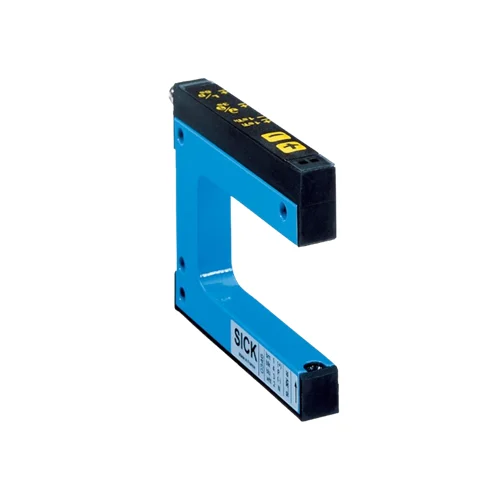
1. Registering labels on a carrier strip
A label feeder can route the carrier through the fork opening and teach the substrate and label conditions while material is stationary. The automatic threshold and subsequent plus/minus adjustment establish the required optical distinction. External indexing logic then uses the selected light/dark event, with actual label contrast and feed timing assessed against the 10 kHz switching and documented response characteristics.
Problem Solved
A taught substrate-to-label transition gives external indexing logic a registration event, helping coordinate label advance with the application sequence using one fixed fork assembly.
Label registration
Two-point teach-in
10 kHz
2. Counting separated small parts in a feed guide
A feed guide can move separated small parts through the infrared path inside the 50 mm fork opening. Each interruption produces a switching event for an external counter using either the PNP or NPN output. The 0.2 mm minimum detectable object, response no greater than 100 µs and 40 µs jitter inform target presentation, part spacing and controller input sampling.
Problem Solved
Optical interruption events give an external counter passage information for separated small parts, helping track feed output without aligning separate sender and receiver units.
Small-part count
0.2 mm MDO
PNP/NPN
3. Identifying sustained occupancy at a transfer guide
A transfer guide can place the expected load path inside the fork so a retained opaque item continues to interrupt the beam. External sequencing measures the duration of the selected output condition and delays upstream release when the position remains occupied. The fixed fork geometry holds the opposed optics together, while the key lock protects the established local settings from unintentional actuation.
Problem Solved
A sustained interruption provides external sequencing with a transfer-occupancy interval, helping distinguish a passing item from one that remains at the guide.
Transfer occupancy
Fixed fork
Key lock