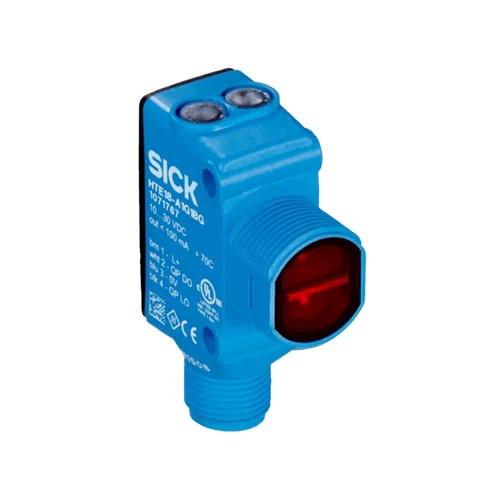
SICK 1073427 HTB18-B4A2BB PNP/NPN Background Suppression Sensor

USD 110.50

Separate PNP and NPN light-switching outputs, right-hand range potentiometer, signal-strength bar, 631 nm red LED and M12 four-pin connection.

SKU SICK-1073427 Category
SICK H18 Sure Sense

SICK HTB18-B4A2BB PNP/NPN Background Suppression Sensor

BrandSICK
Model IdentifierHTB18-B4A2BB
Official Part Number1073427

Technical Overview

The SICK HTB18-B4A2BB is a hybrid photoelectric proximity sensor with background suppression and a visible 631 nm PinPoint LED. Its specified sensing range is 5–150 mm on 6% remission reference black, with a 5–300 mm maximum range on 90% remission reference white. The right-hand potentiometer adjusts sensing range, and the signal-strength light bar supports local setup checks. Separate PNP Q1 and NPN Q2 outputs both use light-switching behavior through an A-coded M12 four-pin male connector. Response is no greater than 0.5 ms with resistive load, with 1,000 Hz switching at a 1:1 light/dark ratio. The blue VISTAL housing supports M18 head mounting or side mounting and provides IP67/IP69K protection.

Hybrid background-suppression sensor with separate light-switching PNP/NPN outputs, range potentiometer, signal-strength light bar and M12 four-pin connection.

Key Features

  • Background-suppression photoelectric proximity sensing
  • 5–150 mm range on 6% reference black; 5–300 mm maximum on 90% reference white
  • 631 nm visible red PinPoint LED; 7 mm spot at 300 mm
  • Right-hand sensing-range potentiometer; no left-hand adjustment function
  • Signal-strength light bar with local power and received-light indicators
  • Separate Q1 PNP and Q2 NPN outputs, both light switching
  • Response ≤0.5 ms with resistive load; 1,000 Hz at 1:1 light/dark ratio
  • 10–30 V DC; ≤100 mA output current
  • A-coded M12 four-pin connector; M18 head mounting or side mounting
  • VISTAL housing and PMMA optics; IP67/IP69K; −40 to +65 °C operation

Set a background-suppressed target zone and observe local signal strength while providing separate PNP and NPN light-switching signals to machine inputs.

Technical Specification Matrix

ParameterValue
Functional principlePhotoelectric proximity sensing with background suppression
Sensing range5–150 mm on 6% remission reference black, DIN 5033
Maximum sensing range5–300 mm on 90% remission reference white, DIN 5033
Gray-target upper limit200 mm maximum upper range on 18% remission gray, manufacturer range diagram
Light sourceVisible red PinPoint LED; 631 nm
Light spot size7 mm at 300 mm; Ø6 mm at 150 mm in manufacturer spot diagram
Average LED service life100,000 h at ambient +25 °C
AdjustmentRight-hand potentiometer sets sensing range; left-hand adjustment function absent
Signal-strength indicationSignal-strength light bar
Switching outputsQ1 PNP; Q2 NPN, separate outputs
Switching modeBoth outputs light switching
Output current≤100 mA
Response time≤0.5 ms signal transit time with resistive load
Switching frequency1,000 Hz at 1:1 light/dark ratio
ConnectionA-coded M12 four-pin male connector
Pin assignment1 BN=L+; 2 WH=Q2 NPN; 3 BU=M; 4 BK=Q1 PNP
Power supply10–30 V DC
Ripple<5 Vpp; remain within supply-voltage tolerances
Current consumption≤20 mA without signal-strength light bar and without load
Circuit protectionSupply and input/output reverse-polarity protection; output overcurrent and short-circuit protection
Protection classIII
Housing designHybrid
Housing material and colorBlue VISTAL plastic
Optics materialPMMA plastic
MountingM18 head mounting or side mounting, 24.1–25.4 mm; M3 mounting holes
Items suppliedOne flat black plastic M18 fastening nut
IndicatorsYellow: received-light condition; green: power on; signal-strength light bar
IP ratingIP67/IP69K
Operating temperature−40 to +65 °C
Storage temperature−40 to +75 °C
EMCEN 60947-5-2; industrial Radio Safety Class A; residential-area radio interference possible
UL fileE189383
MTTFD523.9 years
DCavg0%
Physical Weight (kg)0.018

Industrial Applications

1. Checking a dark component ahead of a fixture background

An assembly fixture can present a dark component within the adjusted sensing zone while a farther fixture surface remains behind it. Background suppression establishes the target condition from one mounting side, and the right-hand potentiometer sets the working range. The 5–150 mm reference-black specification informs setup with the actual component, while external inspection logic samples either the PNP or NPN light-switching signal after presentation.

Problem Solved

A background-suppressed reflected-light condition gives external inspection logic a component-present reference, helping distinguish a loaded fixture position from the farther surface behind it.

Dark-component check Background suppression Range potentiometer

2. Counting separated parts on a short feed track

A feed track can move separated opaque parts through the red sensing spot and send the selected PNP or NPN transitions to an external counter. The documented 1,000 Hz switching and response no greater than 0.5 ms define the sensor timing basis. Target size, actual remission and spacing determine distinct passages, with the range potentiometer placing the intended track location inside the sensing zone.

Problem Solved

Discrete reflected-light transitions give the external counter part-passage events, helping track separated components along a short feed path without installing an opposed receiver.

Part counting 1,000 Hz PNP or NPN

3. Comparing optical signal strength during setup maintenance

A maintenance check can present the same representative component at the established sensing position and compare the signal-strength light bar before and after cleaning or realignment. The green power and yellow received-light indicators provide additional local observations. The right-hand range adjustment retains the intended target zone, while external control readings show whether the light-switching output follows the expected presentation.

Problem Solved

A local signal-strength display helps maintenance assess changes in the received optical condition and the effect of cleaning or alignment work using the same reference target.

Signal-strength bar Reference-target check Local indication

Select your currency