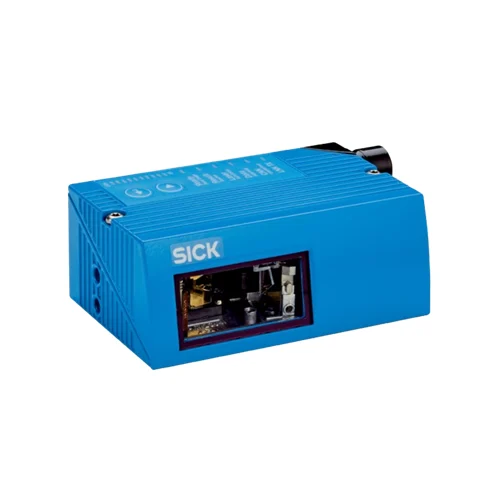
SICK 1042121 CLV650-0120 Autofocus Ethernet 1D Barcode Scanner

USD 4,565.86

Autofocus 1D line scanning at 600–1,000 Hz, 140–1,625 mm reading envelope, 0.25–1 mm code resolution, Ethernet and swivel-mounted M12 connectors.

SKU SICK-1042121 Category
SICK Fixed Mount Barcode Scanners

SICK CLV650-0120 Autofocus Ethernet 1D Barcode Scanner

BrandSICK
Model IdentifierCLV650-0120
Official Part Number1042121

Technical Overview

The SICK CLV650-0120 is a Standard Density fixed-mount 1D barcode line scanner with autofocus and a front reading field. Its visible 658 nm Class 2 laser operates at 600–1,000 Hz, with a 140–1,625 mm reading envelope that depends on code resolution and reading-field geometry. Ethernet TCP/IP carries results and service data at 10/100 Mbit/s, alongside the documented industrial and serial interfaces. The swivel connection assembly provides an M12 12-pin male connector and four-pin female connector. SOPAS ET supports configuration, with local buttons, result indication and a reading-rate bar graph assisting setup. The 18–30 V DC scanner consumes 8.5 W and uses an IP65 die-cast aluminum housing with a glass window.

Autofocus 1D laser barcode scanner with front reading field, Ethernet, 600–1,000 Hz scanning, 0.25–1 mm code resolution and swivel M12 connections.

Key Features

  • Standard Density 1D barcode line scanner with front reading field
  • Autofocus; 140–1,625 mm reading envelope depends on code resolution
  • 658 nm visible red Class 2 laser; aperture angle ≤50°
  • 600–1,000 Hz scanning; 0.25–1 mm code resolution
  • Ethernet TCP/IP, PROFINET Single Port and EtherNet/IP at 10/100 Mbit/s
  • Serial RS-232/RS-422/RS-485 and CAN/CANopen interfaces
  • Swivel-mounted M12 12-pin male and four-pin female connectors
  • Up to 20 codes per scan with Standard decoder; up to 50 per reading interval
  • SOPAS ET configuration, reading-rate bar graph and configurable beeper
  • 18–30 V DC, 8.5 W; die-cast aluminum, glass window and IP65

Read printed 1D codes with autofocus and send decoded results over Ethernet, while local reading-rate indication supports setup and troubleshooting.

Technical Specification Matrix

ParameterValue
Product typeFixed-mount 1D barcode line scanner
VersionStandard Density
Reading fieldFront
Optical focusAutofocus
Light sourceVisible red laser, 658 nm
Laser classClass 2; EN 60825-1:2014+A11:2021 / IEC 60825-1:2014; 21 CFR 1040.10 subject to Laser Notice No. 56, May 8, 2019
Aperture angle≤50°
Reading distance140–1,625 mm; depends on module resolution and reading-field diagram
Scanning frequency600–1,000 Hz
Code resolution0.25–1 mm
Readable code structures1D codes on printed labels
Barcode typesCode 39, Code 128, Code 93, Codabar, GS1-128/EAN 128, UPC/GTIN/EAN, Interleaved 2 of 5, Pharmacode, GS1 DataBar, Telepen and MSI/Plessey
Print ratio2:1–3:1
Codes per scan1–20 with Standard decoder; 1–6 with SMART decoder
Codes per reading interval1–50, auto-discriminating
Characters per reading interval5,000; 500 with CAN multiplexer function
Multiple readings1–99
EthernetTCP/IP; result-data and service interface; 10/100 Mbit/s
PROFINETSingle Port; Dual Port optional via external CDF600-2 connection module; 10/100 Mbit/s
EtherNet/IP10/100 Mbit/s
EtherCAT integrationOptional via external CDF600 fieldbus module
Serial interfacesRS-232, RS-422 and RS-485; result-data and service interface
Serial transmission rate2,400 baud–115.2 kbaud; AUX RS-232: 57.6 kbaud
CANSICK CAN sensor network CSN, controller/device and multiplexer/server; 20 kbit/s–1 Mbit/s
CANopen20 kbit/s–1 Mbit/s
PROFIBUS DP integrationOptional via external CDF600-2 fieldbus module
Digital inputsSensor 1 input; two additional inputs via optional CMC600 parameter memory in CDB620/CDM420
Digital outputsTwo via optional CMC600 parameter memory in CDB620/CDM420
Reading triggersDigital input; non-powered; serial interface; auto pulse; CAN
Local indicationSix status LEDs and ten-LED bar graph for reading-rate percentage
Acoustic indicationConfigurable beeper/buzzer; can be disabled or allocated to result indication
ControlsTwo function buttons
Configuration softwareSOPAS ET
Memory cardOptional microSD flash memory card
ConnectionTwo M12 connectors on swivel assembly: A-coded 12-pin male; D-coded four-pin female
Power supply18–30 V DC
Power consumption8.5 W
Housing material and colorLight-blue RAL 5012 die-cast aluminum
Window materialGlass
IP ratingIP65, EN 60529
Protection classIII, EN 61140
MountingTwo M5 blind threaded holes, 5 mm deep
MTBF100,000 h
Laser-diode MTTF40,000 h at +25 °C
Operating temperature0 to +40 °C
Storage temperature−20 to +70 °C
Relative humidity90%, non-condensing
Ambient light immunity2,000 lx on barcode
Barcode print contrastPCS ≥60%
EMCEN 61000-6-3:2001-10 / EN 61000-6-2:2005
Vibration resistanceEN 60068-2-6:1995
Shock resistanceEN 60068-2-27:1993
Physical Weight (kg)0.25

Industrial Applications

1. Identifying cartons at a conveyor routing station

A conveyor routing station can present printed 1D carton labels through the scanner’s front reading field and send decoded identifiers to external sorting logic over Ethernet. Autofocus accommodates the supported reading geometry, while the 600–1,000 Hz scanning range provides the acquisition basis. Installation uses the actual label module width and print contrast to select a working position inside the resolution-dependent reading field.

Problem Solved

Decoded carton identifiers give external routing logic a machine-readable destination reference, helping associate each presented carton with its configured path through the handling system.

Carton identification Autofocus Ethernet TCP/IP

2. Comparing multiple printed labels at an assembly checkpoint

An assembly checkpoint can present several printed 1D labels within the line-scanning geometry and pass the decoded strings to external validation software. The Standard decoder supports up to 20 codes per scan, and the reading interval supports up to 50 auto-discriminated codes. External logic compares the collected identifiers with its expected assembly record, with label placement and module size governing optical coverage.

Problem Solved

Multiple decoded identifiers give external validation software a set of assembly references to compare, helping detect a missing or mismatched printed label at the checkpoint.

Multiple-code check Standard decoder External validation

3. Assessing read reliability after label or alignment changes

A maintenance station can repeatedly present representative printed labels and observe the reading-rate bar graph and result indications before and after setup changes. SOPAS ET configures the reader, while the local buttons and configurable beeper support controlled checks. The comparison uses the same label geometry, contrast and ambient lighting so that changes in read success can be assessed consistently.

Problem Solved

Visible reading-rate and result indications help maintenance compare setup changes against a representative label presentation, supporting investigation of missed reads without claiming a barcode-quality grade.

Read-rate check SOPAS ET Result indication
Select your currency