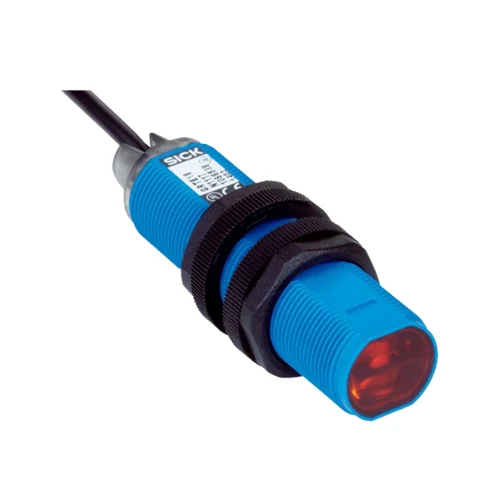
SICK 1067974 GRTE18-P1167 M18 PNP Diffuse Photoelectric Sensor

USD 40.04

Energetic red-LED sensing with 10–800 mm white-target range, complementary PNP outputs, 500 Hz switching, 270° adjustment and a 2 m PVC cable.

SKU SICK-1067974 Category
SICK GR18

SICK GRTE18-P1167 M18 PNP Diffuse Photoelectric Sensor

BrandSICK
Model IdentifierGRTE18-P1167
Official Part Number1067974

Technical Overview

The SICK GRTE18-P1167 is an energetic photoelectric proximity sensor with axial red-LED emission in an M18 ×1 cylindrical plastic housing. Its sensing range is 10–800 mm on the specified 90% remission white target, with a 5–1,000 mm maximum range; darker targets have shorter documented ranges. A 270° potentiometer adjusts sensitivity, while complementary PNP outputs provide light and dark switching signals. The 650 nm LED produces a 45 mm spot at 800 mm, with response below 1,000 µs and 500 Hz switching under the stated test conditions. A 2 m four-wire PVC cable, two mounting nuts, ABS housing and PMMA optics complete the IP67 sensor.

M18 energetic red-LED proximity sensor with 10–800 mm white-target range, complementary PNP outputs, 500 Hz switching and a 2 m PVC cable.

Key Features

  • Energetic reflected-light sensing with axial optical axis
  • M18 ×1 cylindrical ABS housing; two plastic mounting nuts supplied
  • 10–800 mm sensing range on 90% remission white reference target
  • 5–1,000 mm maximum range on the same white reference target
  • 650 nm red LED; Ø45 mm spot at 800 mm
  • 270° sensitivity potentiometer with green power and yellow received-light indicators
  • Complementary PNP light/dark outputs; current derating above 24 V or +49 °C
  • Response <1,000 µs with resistive load; 500 Hz at 1:1 light/dark ratio
  • 10–30 V DC supply; 2 m four-wire PVC cable
  • IP67; −25 to +55 °C operation subject to supply and load conditions

Detect reflected light from a target using adjustable M18 optics and complementary PNP signals, with mounting access required from only the sensing side.

Technical Specification Matrix

ParameterValue
Functional principleEnergetic photoelectric proximity sensing
Housing designCylindrical; M18 ×1 thread
Optical axisAxial
Sensing range10–800 mm on 90% remission white target, DIN 5033
Maximum sensing range5–1,000 mm on 90% remission white target, DIN 5033
Black-target range6% remission: sensing 20–200 mm; typical maximum 15–300 mm, range diagram
Gray-target range20% remission: sensing 15–360 mm; typical maximum 10–500 mm, range diagram
Light sourceVisible red LED; wavelength 650 nm
Average LED service life100,000 h at ambient +25 °C
Light spot sizeØ9 mm at 40 mm; Ø12 mm at 200 mm; Ø45 mm at 800 mm; Ø60 mm at 1,000 mm
AdjustmentPotentiometer, 270°
IndicatorsGreen on: power; yellow on: object present; yellow off: object absent
Power supply10–30 V DC; short-circuit-protected network, maximum 8 A
Ripple<5 Vpp; remain within supply-voltage tolerances
Current consumption30 mA
Switching outputsComplementary PNP, light/dark switching
Signal voltage HIGH/LOWSupply voltage minus a drop ≤3 V / approximately 0 V
Output current≤100 mA; maximum 50 mA if supply >24 V or ambient >49 °C
Response time<1,000 µs with resistive load
Switching frequency500 Hz at 1:1 light/dark ratio
Connection2 m four-wire PVC cable; do not bend below 0 °C
Wire assignmentCD-094: BN=L+; BU=M; BK=Q; WH=Q̅
Circuit protectionSupply reverse-polarity protection; input/output reverse-polarity protection; output overcurrent and short-circuit protection
Protection classIII
Housing materialABS plastic
Optics materialPMMA plastic
IP ratingIP67
Items suppliedTwo plastic fastening nuts, width across flats 22 mm
EMCEN 60947-5-2
Operating temperature−25 to +55 °C at supply ≤24 V and output current <50 mA
Storage temperature−40 to +70 °C
UL fileE348498

Industrial Applications

1. Confirming a part in a one-sided assembly fixture

An assembly fixture can aim the sensor at the exposed face of a component and send its complementary PNP signals to external sequencing inputs. Energetic sensing uses light returned from that face, so the arrangement does not require a receiver on the opposite side. The fixture fixes target position and surface presentation within the relevant white, gray or black target range.

Problem Solved

Reflected-light detection provides external sequencing with a component-presence condition, helping confirm that a presented part occupies the fixture before the next machine step.

Fixture presence One-sided sensing PNP outputs

2. Counting separated opaque packages at a conveyor side

A conveyor can present separated opaque packages past the axial beam and send each returned-light transition to an external counter. The 270° potentiometer adapts sensitivity to the actual package surface and working distance. Package coverage, spacing and speed determine usable events within the documented response below 1,000 µs and 500 Hz light/dark switching conditions.

Problem Solved

Repeated reflected-light transitions give the external counter discrete package-passage events, helping track separated loads when their surfaces and spacing produce distinct detection intervals.

Package passage 500 Hz Sensitivity adjustment

3. Watching strip continuity above a non-reflecting gap

A feed station can aim the sensor at an opaque strip spanning a non-reflecting opening and use loss of returned light as a discontinuity event. External machine logic interprets that event during the feed sequence. Sensitivity and standoff are set for the actual strip surface, and the opening geometry keeps surrounding structure outside the intended reflected-light presentation.

Problem Solved

A loss-of-return event gives external feed logic a strip-absence reference, helping identify a break or exhausted material presentation before the next processing operation.

Strip continuity Reflected-light return Complementary PNP

Select your currency