1. Counting separated loads across a conveyor opening
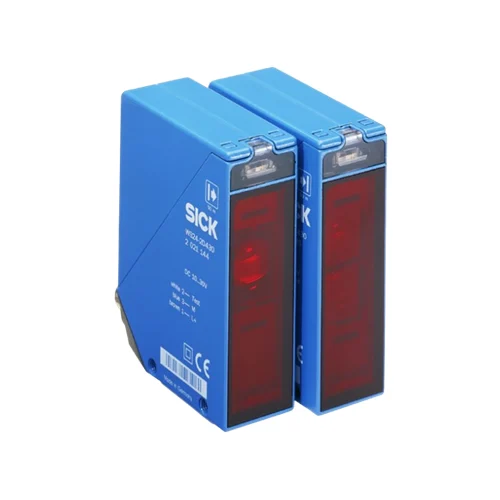
A conveyor can place the sender and receiver on opposite sides of an opening and send beam-interruption transitions to an external counter. The documented 0–50 m sensing range supports separation across the installation, while visible red light, the alignment sight and signal-strength indication assist setup. Load coverage and spacing govern usable events within the stated response and switching conditions.
Problem Solved
Direct beam interruption gives an external counter discrete load-passage events, helping track separated material without relying on light returned from each target surface.
Through-beam counting
50 m
External counter
2. Qualifying prolonged occupancy at a transfer point
A transfer station can use continued beam interruption to identify an opaque load that remains in the handover position. The receiver’s local switch-on or off delay, selected to suit its light/dark output state, provides a qualified switching event to external sequencing. The 0.5–10 s adjustment distinguishes a brief passage from occupancy extending beyond the configured interval.
Problem Solved
Local timing gives external sequencing a duration-qualified occupancy event, helping distinguish normal movement from a load that remains across the transfer beam.
Transfer dwell
0.5–10 s delay
Selectable logic
3. Testing the optical signal path during a machine check
A machine check can hold the physical beam path clear and connect the sender test input to 0 V to turn emission off. External diagnostic logic observes the receiver transition through its selected PNP/NPN and light/dark output configuration, accounting for any enabled local delays. Restoring emission provides a second controlled state for comparison with the expected response.
Problem Solved
Controlled sender-off operation gives external diagnostic logic a reproducible interruption, helping test the optical signal chain without moving a physical test target across the opening.
Sender test
TE to 0 V
Signal-chain check