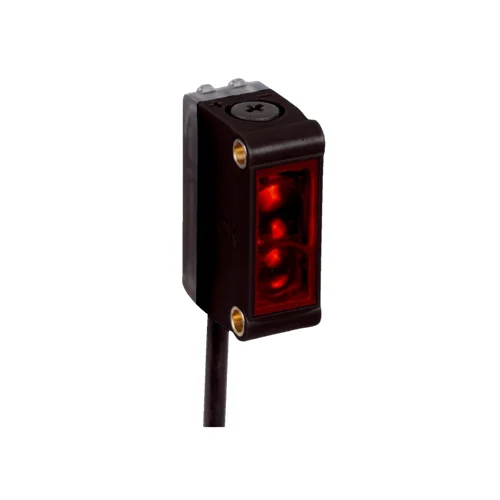
1. Checking a component in front of a fixture backplate
An assembly fixture can present a component between the sensor and a more distant backplate. Background suppression and the five-turn adjustment establish a nearby detection region, while the PNP light-switching signal reports the presented component to external inspection logic. Setup verifies actual target remission, seated distance and background separation within the specified sensing range.
Problem Solved
A nearby-target reference helps external inspection logic distinguish a loaded fixture from an empty location even when a more distant backplate remains in view.
Fixture check
Background suppression
Five-turn adjustment
2. Counting separated parts along a guided conveyor
A guide can keep successive opaque parts at a repeatable distance from the sensor while leaving the more distant machine structure behind them. Each part changes the PNP light-switching state for an external counter. Commissioning verifies target reflectance and separation, and evaluates part transit and gaps against the below-1-ms resistive-load response and 500 Hz rating.
Problem Solved
Distinct part passages provide electrical events to external counting logic, with background suppression helping keep a more distant frame from becoming the selected target.
Part counter
500 Hz
PNP output
3. Monitoring continuity of a supported opaque strip
A strip-feeding station can aim the infrared sensor at a supported opaque strip with a more distant surface behind the path. Adjustment places the expected strip within the detection region, and background suppression separates it from that background. External feed logic interprets a sustained absence state as a possible break or runout after material-specific commissioning.
Problem Solved
A strip-present condition gives external feed logic a continuity reference, helping identify loss of material while the sensor and wiring remain on one mounting side.
Strip continuity
Infrared light
Background separation