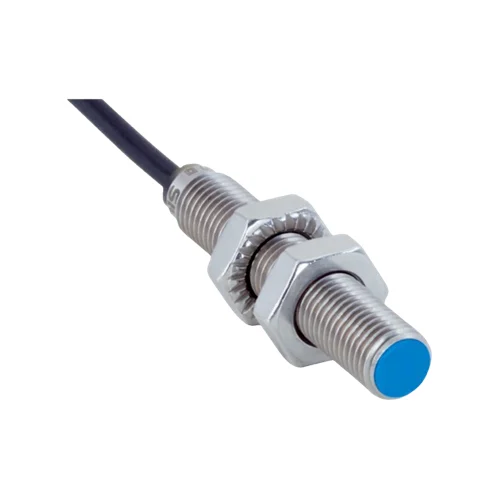
1. Confirming a metal clamping slide in a coolant zone
A machine-tool fixture can bring a metal target on a clamping slide toward the flush sensing face and use the PNP normally-open state as an external sequence input. The stainless steel housing, LCP sensing face and documented coolant-lubricant resistance suit the stated environment. Setup evaluates the actual coolant and target material, preserves installation clearances and establishes the gap using the visual adjustment indicator.
Problem Solved
A noncontact metal-target condition gives external fixture logic a slide-position reference, helping coordinate the machining sequence with the presented mechanical position in the coolant zone.
Clamp-slide position
Coolant resistance
Visual adjustment
2. Counting separated metal features on a fast indexing mechanism
An indexing mechanism can present separated metal tabs to the sensor and route the PNP normally-open transitions to an external counter. The 4,000 Hz switching rating informs the available timing, while the installed gap remains within the assessed target range. Commissioning checks tab geometry, metal reduction factors and receiver response at the intended speed so that each feature produces a distinct event.
Problem Solved
Successive inductive target transitions give external counting logic index events, helping track repeated metal features without placing a contact switch against the rotating mechanism.
Metal-feature counting
4,000 Hz
PNP NO
3. Reviewing target-gap states through IO-Link during setup
A commissioning station can connect the sensor to an IO-Link master and read the one-byte process data while moving a representative metal target toward the sensing face. Bit 0 reports Sr reached and bit 1 reports Sa reached, supplementing the local visual adjustment indication. The setup procedure relates those documented states to the required target position and records the observed result in external machine diagnostics.
Problem Solved
Separate reported range states give external setup diagnostics more information than one switching condition, helping verify that the target reaches the intended assured detection region.
IO-Link setup
Sr/Sa states
Target-gap verification