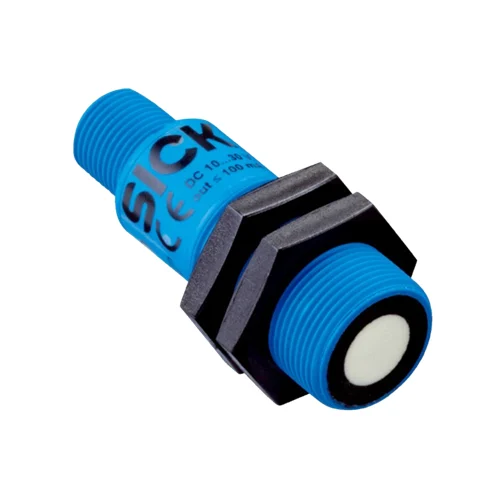
SICK 6048408 UM18-217161101 Short-Range PNP Ultrasonic Sensor

USD 254.02

Ultrasonic sensor with 20–150 mm operating range, one teachable PNP output, window and background modes, 32 ms response and M12 four-pin connector.

SKU SICK-6048408 Category
Ultrasonic Distance Sensors - SICK UM18

SICK UM18-217161101 Short-Range PNP Ultrasonic Sensor

BrandSICK
Model IdentifierUM18-217161101
Official Part Number6048408

Technical Overview

The SICK UM18-217161101 is a straight-axis ultrasonic sensor with a 20–150 mm operating range and a 250 mm limiting range dependent on target reflection, size and alignment. A typical 380 kHz ultrasonic signal supports detection through one teachable PNP output, with distance-to-object, window and object-between-sensor-and-background switching modes. The output can be inverted, and a separate teach-in connection is provided on pin 2. Response time is 32 ms, switching frequency 25 Hz and output time 8 ms. The 10–30 V DC device uses an M18 ×1 PBT housing, M12 four-pin connector and two LEDs, with IP65/IP67 protection and operation from −25 to +70 °C.

Straight-axis ultrasonic sensor with 20–150 mm operating range, one teachable PNP output, window switching and M12 four-pin connector.

Key Features

  • 20–150 mm operating range; 250 mm target-dependent limiting range
  • Typical 380 kHz ultrasonic frequency; straight sending axis
  • One PNP output; ≤200 mA maximum output current
  • Distance, window and object-between-sensor-and-background modes
  • Digital-output teach-in, output inversion and factory reset
  • 32 ms response; 25 Hz switching; 8 ms output time
  • ≥0.2 mm resolution; ±1% accuracy relative to current measured value
  • 10–30 V DC; ≤1.2 W without load; initialization <300 ms
  • M18 ×1 PBT housing; M12 four-pin connector with separate teach-in pin
  • Two LEDs; IP65/IP67; −25 to +70 °C operation

Teach an ultrasonic distance condition or window and provide a PNP process signal from a compact M18 sensing location.

Technical Specification Matrix

ParameterValue
Functional principleUltrasonic distance sensing with digital output
Operating range20–150 mm
Limiting range250 mm; detection depends on target reflection, size and alignment
Resolution≥0.2 mm
Repeatability±0.15% of current measured value; minimum value ≥resolution
Measurement accuracy±1% of current measured value
Response time32 ms
Switching frequency25 Hz
Output time8 ms
Ultrasonic frequencyTypical 380 kHz
Switching modesDistance to object (DtO); window (Wnd); object between sensor and background (ObSB)
AdjustmentTeach-in of digital output; invertible digital output; factory reset
Digital outputOne PNP output; maximum current ≤200 mA
Signal voltage HIGH/LOWVs −(<2 V) / 0 V
Hysteresis2 mm
Power supply10–30 V DC; limit values, reverse-polarity protected; short-circuit-protected network maximum 8 A, Class 2
Power consumption≤1.2 W without load
Initialization time<300 ms
IndicatorsTwo LEDs
IP ratingIP65 / IP67
Protection classIII
Housing designCylindrical; straight sending axis
Mounting threadM18 ×1
Housing materialPBT plastic; ultrasonic transducer uses polyurethane foam and glass epoxy resin
ConnectionM12 four-pin male connector
Pin assignment1 BN=L+; 2 WH=teach-in; 3 BU=M; 4 BK=Q / inverted Q
Mounting nuts in drawingFixing nuts, 24 mm across flats
Operating temperature−25 to +70 °C
Storage temperature−40 to +85 °C
Temperature drift0.17%/K of current measured value
MTTFD101 years
DCavg0%
Physical Weight (kg)0.015

Industrial Applications

1. Checking a presented assembly in a distance window

An assembly fixture can present a reflective component surface within the ultrasonic operating range and teach a window around its expected seated distance. The PNP output provides the resulting condition to external inspection logic after the part settles. Commissioning uses representative surface geometry and alignment, accounting for the 2 mm hysteresis, measured-value accuracy and documented response rather than treating the output as a numeric distance signal.

Problem Solved

A taught acoustic distance-window condition helps external inspection logic distinguish the expected seated surface from a displaced assembly before the fixture advances.

Seated-part window PNP output Ultrasonic sensing

2. Reporting a material-level threshold in a small container

A small-container station can position the sensor above a suitably reflecting material surface and teach a distance threshold inside the 20–150 mm operating range. As the surface reaches that condition, the PNP output supplies an event to external replenishment control. Commissioning evaluates actual surface shape, reflection, vessel-wall echoes and the near-field limit, with timing appropriate to the stated 32 ms response.

Problem Solved

An acoustic surface-threshold event gives external replenishment logic a material-level reference, helping coordinate feed changes at the selected container condition without a contact probe.

Level threshold Distance teach-in External feed control

3. Counting separated packages at a guided passage

A guided passage can move separated packages with suitably reflecting faces through the assessed ultrasonic detection area. The taught PNP switching condition feeds an external counter as each package enters and leaves the sensing zone. Commissioning checks package geometry, alignment and spacing against the target-dependent detection area, 25 Hz switching limit and 32 ms response so that distinct passage events can be evaluated.

Problem Solved

Successive acoustic target transitions provide external counting logic with package-passage events, helping track separated loads using a sensing condition based on the presented ultrasonic reflection.

Package count 25 Hz Acoustic reflection

Select your currency