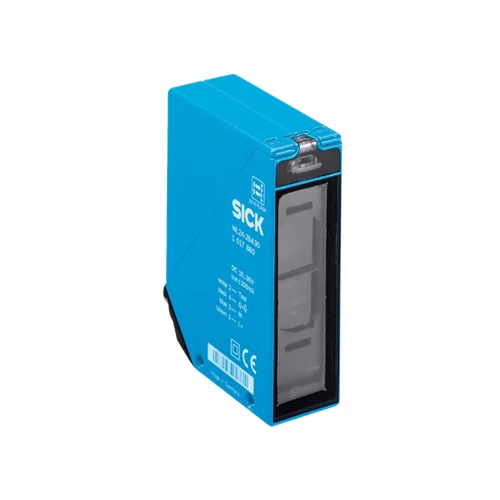
1. Confirming an opaque load at a transfer position
A transfer station can place a PL80A reflector opposite the sensor so that an opaque load interrupts the established optical path at its intended position. External sequencing logic reads the selected switching condition after the load settles. The sensitivity potentiometer and signal-strength indicator assist alignment, with the installed separation kept inside the detailed PL80A sensing range and the minimum reflector distance observed.
Problem Solved
Beam interruption at the transfer position supplies external sequencing with a load-present condition, helping distinguish an occupied station from a clear optical path before material release.
Transfer presence
PL80A reflector
Selectable output
2. Counting separated cartons across a conveyor
A conveyor can pass separated opaque cartons through the sensor-to-reflector path and send output transitions to an external counter. The 1,000 Hz rating and ≤500 µs resistive-load response inform timing assessment together with carton spacing, belt speed and receiver response. NPN/PNP and light/dark selection adapt the event condition to the intended control input, while alignment establishes a clear path between cartons.
Problem Solved
Repeated beam interruptions provide external counting logic with carton-passage events, helping track separated material movement across a defined conveyor point using a single wired sensor location.
Carton counting
1,000 Hz
Retro-reflective path
3. Exercising the optical path during a controlled machine check
During a controlled machine check with an unobstructed reflector path, external control can bring the test input to 0 V to turn off the sender. The controller then observes the selected switching condition and restores the sender to compare the result. This process check uses the documented TE function and configured output behavior; it does not establish a safety-rated diagnostic function.
Problem Solved
Commanding sender-off provides a repeatable optical stimulus for external process checks, helping maintenance compare the input and output response through the installed sensor connection.
Sender-off check
TE to 0 V
External observation