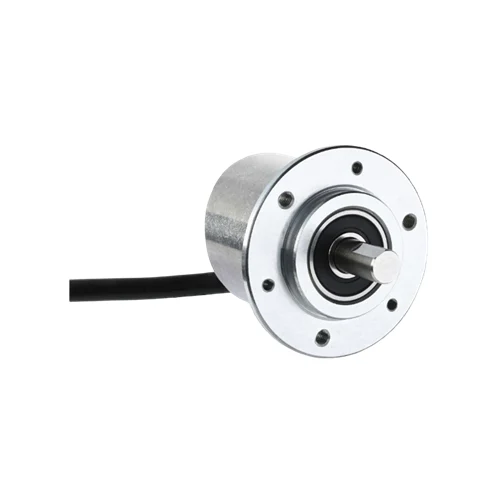
SICK 1066108 360 PPR HTL Encoder with 5 m PVC Cable

USD 133.64

360 PPR encoder with six-channel HTL push-pull feedback, 8 mm solid shaft with flat, face-mount flange, 5 m eight-wire PVC cable and IP65 housing.

SKU SICK-1066108 Category
SICK Encoders

SICK DBS50E-S5EM00360 360 PPR HTL Incremental Encoder

BrandSICK
Model IdentifierDBS50E-S5EM00360
Official Part Number1066108

Technical Overview

The SICK DBS50E-S5EM00360 is a 360-pulse-per-revolution incremental encoder with six-channel HTL push-pull feedback and a 7–30 V supply. It provides A, B and Z signals with their complements, including one reference signal gated over 90 electrical degrees with A and B. The stainless steel solid shaft has an 8 mm diameter, 15.5 mm length and flat, with a face-mount flange and aluminum housing. A universal 5 m eight-wire PVC cable connects the encoder to external counting electronics. Output frequency is limited to 300 kHz, with initialization below 3 ms. Rated speed is 6,000 rpm with self-heating considered; IP65 protection and −20 to +85 °C standard operation complete the configuration.

360 PPR six-channel HTL push-pull encoder with 7–30 V supply, 8 mm solid shaft with flat and 5 m PVC cable.

Key Features

  • 360 pulses per revolution; incremental shaft-rotation feedback
  • Six HTL push-pull channels: A, B, Z and their complements
  • One reference signal; 90 electrical degrees, logically gated with A and B
  • Output frequency ≤300 kHz; initialization <3 ms
  • 7–30 V supply; <0.5 W consumption without load; load current ≤30 mA
  • 8 mm × 15.5 mm stainless steel solid shaft with flat; face-mount flange
  • Universal 5 m eight-wire PVC cable; aluminum flange and housing
  • 6,000 rpm operation with 3.3 K self-heating per 1,000 rpm allowance
  • IP65; −20 to +85 °C standard operating range
  • Reverse-polarity protection; output short-circuit protection when supply and ground are correctly connected

Provide incremental rotation and a gated revolution reference to external counting electronics through six-channel HTL push-pull feedback.

Technical Specification Matrix

ParameterValue
Encoder typeIncremental encoder
Pulses per revolution360
Measuring step90 electrical degrees / pulses per revolution
Measuring step deviation±18° / pulses per revolution
Error limits±54° / pulses per revolution
Communication interfaceHTL / push-pull, incremental
Signal channelsSix: A, A complement, B, B complement, Z and Z complement
Reference signalOne; 90 electrical degrees, logically gated with A and B
Initialization time<3 ms
Output frequency≤300 kHz
Load current≤30 mA
Power consumption<0.5 W without load
Power supply7–30 V
Reverse-polarity protectionProvided
Output short-circuit protectionProvided when Us and GND are correctly connected
ConnectionUniversal 5 m eight-wire PVC cable
Mechanical designSolid shaft, face-mount flange
Shaft diameter8 mm, f7
Shaft length15.5 mm
Shaft characteristicWith flat
Shaft materialStainless steel
Flange materialAluminum
Housing materialAluminum
Start-up torque0.9 Ncm at +20 °C
Operating torque0.6 Ncm at +20 °C
Permissible shaft loading30 N axial; 50 N radial
Operating speed6,000 rpm; allow self-heating of 3.3 K per 1,000 rpm when designing operating-temperature range
Maximum operating speed8,000 rpm; no permanent operation; decreasing signal quality
Rotor moment of inertia0.65 gcm²
Bearing lifetime2 × 10⁹ revolutions
Angular acceleration≤500,000 rad/s²
Mounting patternThree M4 or three M3 tapped holes, 6 mm deep, each pattern at 120° on 40 mm pitch circle
IP ratingIP65
EMCEN 61000-6-2 and EN 61000-6-3, Class A
Relative humidity90%; condensation not permitted
Operating temperature−20 to +85 °C standard; −35 to +95 °C on request
Storage temperature−40 to +100 °C without packaging
Shock resistance100 g, 6 ms; EN 60068-2-27
Vibration resistance20 g, 10–2,000 Hz; EN 60068-2-6
MTTFD600 years, EN ISO 13849-1; nominal component loading, average ambient 40 °C, 8,760 h/year, all electronic failures considered hazardous; standard product, not a safety component
Physical Weight (kg)0.17

Industrial Applications

1. Monitoring the speed of a driven roller

A machine can mechanically couple the encoder shaft to a driven roller and feed HTL push-pull pulses to compatible counting electronics. External control calculates rotational speed from pulse frequency using the verified 360 pulses per revolution. Installation respects shaft loading, coupling alignment and the operating-speed thermal allowance, while input electronics remain within the documented output frequency and electrical limits.

Problem Solved

A pulse-frequency reference lets external drive-monitoring logic compare actual roller rotation with the commanded speed, supporting adjustment or a configured deviation indication during operation.

Roller speed 360 PPR HTL feedback

2. Measuring relative travel of a screw-driven carriage

A positioning axis can couple the encoder to its screw drive and count incremental pulses from an established reference. External motion logic converts shaft rotation into relative carriage travel using the actual screw pitch and mechanical ratio. The six signal channels support compatible quadrature counting electronics, with commissioning verifying direction, shaft loads and the required reference procedure.

Problem Solved

Incremental rotation counts give external motion logic a relative travel reference across the stroke, helping compare commanded carriage movement with rotation measured at the coupled drive.

Relative travel Quadrature counting External coordinate

3. Referencing a rotary mechanism once per revolution

A rotary machine can use the gated Z reference signal alongside the A and B channels to establish a recurring angular reference in compatible control electronics. The encoder provides one reference signal with 90 electrical-degree gating. Commissioning aligns that reference to the mechanism, while external logic combines it with incremental counts to track movement through successive rotations.

Problem Solved

A recurring shaft-reference event lets external control check or establish its incremental count reference each revolution, helping relate counted movement to a commissioned mechanical position.

Revolution reference Gated Z signal Incremental counts

Select your currency