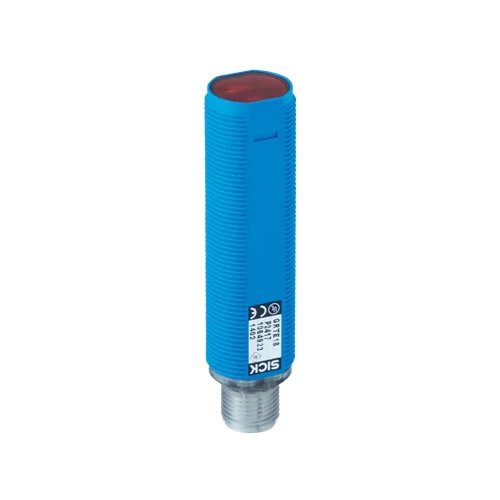
SICK 1076981 GRL18-P2457 PNP Retro-reflective Sensor

USD 49.14

PNP complementary outputs, 650 nm red PinPoint LED, 270° sensitivity adjustment and M12 connection; IP67 ABS plastic housing and P250 reflector.

SKU SICK-1076981 Category
SICK GR18

SICK GRL18-P2457 PNP Retro-reflective Sensor

BrandSICK
Model IdentifierGRL18-P2457
Official Part Number1076981

Technical Overview

The SICK GRL18-P2457 is an M18 photoelectric retro-reflective sensor with an axial dual-lens system and polarization filter. Its 650 nm visible red PinPoint LED works with an opposing reflector, and a 270° potentiometer adjusts sensitivity. The supplied P250 reflector has a 0.06–5.4 m sensing range, while the PL80A reference gives 0.06–6 m. Complementary PNP outputs support light/dark switching through an M12 four-pin male connector. Response is below 500 µs with a resistive load, and switching frequency is 1,000 Hz at a 1:1 light/dark ratio. The ABS plastic housing provides IP67 protection. Supply is 10–30 V DC; output-current and operating-temperature limits depend on voltage and ambient conditions.

M18 red LED retro-reflective sensor with complementary PNP outputs, sensitivity potentiometer, M12 four-pin connector and supplied P250 reflector.

Key Features

  • Dual-lens retro-reflective sensing with minimum reflector distance and polarization filter
  • 650 nm visible red PinPoint LED; Ø175 mm light spot at 7 m
  • 0.06–6 m sensing range with PL80A; maximum 0.03–7.2 m
  • Supplied P250 reflector: 0.06–5.4 m sensing range; maximum 0.03–6.4 m
  • PNP complementary outputs; light/dark switching
  • <500 µs resistive-load response; 1,000 Hz at 1:1 light/dark ratio
  • 270° sensitivity potentiometer; separate power and received-light indicators
  • M18 × 1 axial cylindrical housing; M12 four-pin male connector
  • 10–30 V DC; 30 mA consumption; ≤100 mA output with stated derating
  • ABS plastic housing, PMMA optics and IP67; two fastening nuts supplied

Use the supplied P250 reflector and complementary PNP signals to report interruptions of a defined optical path to external machine control.

Technical Specification Matrix

ParameterValue
Functional principlePhotoelectric retro-reflective sensor; dual-lens system with minimum reflector distance
Mounting threadM18 × 1; cylindrical housing, axial optical axis
Sensing range0.06–6 m with PL80A reflector
Maximum sensing range0.03–7.2 m with PL80A reflector
Range with supplied P250 reflector0.06–5.4 m sensing range; 0.03–6.4 m maximum range
Ranges with other reflectorsPL40A: 0.06–5.2 m sensing / 0.03–6.2 m maximum; PL20A: 0.06–2.9 m / 0.03–3.8 m; PL22: 0.06–1.9 m / 0.03–2.2 m; REF-Plus 3436 tape: 0.08–1.6 m / 0.06–2.0 m
Light source650 nm visible red PinPoint LED
Light spot sizeØ175 mm at 7 m; diagram also gives Ø8 mm at 0.2 m, Ø25 mm at 1 m and Ø75 mm at 3 m
Average LED service life100,000 h at ambient +25 °C
Polarization filterProvided
AdjustmentSensitivity potentiometer, 270°
IndicatorsGreen: power on; yellow: on when object absent, off when object present
Switching outputPNP
Output functionComplementary Q and Q complement
Switching modeLight/dark switching
Signal voltage HIGH/LOWVs − (≤3 V) / approximately 0 V
Output current≤100 mA; maximum 50 mA when supply >24 V or ambient temperature >49 °C
Response time<500 µs; signal transit time with resistive load
Switching frequency1,000 Hz at light/dark ratio 1:1
ConnectionM12 four-pin male connector
Pin assignmentCD-084: 1 BN=L+; 2 WH=Q complement; 3 BU=M; 4 BK=Q
Power supply10–30 V DC; limit values; short-circuit-protected network, maximum 8 A
Ripple<5 Vpp; supply must remain within voltage tolerances
Current consumption30 mA
Circuit protectionA: supply reverse-polarity protection; B: input/output reverse-polarity protection; D: output overcurrent and short-circuit protection
Protection classIII
Housing materialABS plastic
Optics materialPMMA plastic
IP ratingIP67
Items suppliedTwo fastening nuts, plastic; 22 mm across flats; P250 reflector
Axial drawing length73.5 mm including integral male connector
EMCEN 60947-5-2
Operating temperature−25 to +55 °C at supply ≤24 V and output current <50 mA
Storage temperature−40 to +70 °C
UL fileE348498
Certificates listedEU, UK, ACMA and Moroccan declarations of conformity; China RoHS; CCC exempt; ECOLAB; cULus; DIN EN 62471 photobiological safety
MTTFD2,412 years
DCavg0%

Industrial Applications

1. Counting separated opaque cartons on a conveyor

A packaging conveyor can position the sensor and reflector on opposite sides of the carton path. Each opaque carton interrupts the returned red beam, providing a PNP switching transition to an external counter. Carton length, spacing and conveyor speed are assessed against the response time below 500 µs and 1,000 Hz switching rating. The installed reflector and distance determine the available sensing range.

Problem Solved

Beam-interruption events give external counting logic a passage reference for separated cartons, allowing production totals to follow actual material movement without a contacting switch.

Carton passage External counting 1,000 Hz

2. Monitoring continuity of an opaque material web

A converting station can place an opaque web across the sensor-to-reflector path so normal material blocks the returned beam. A break or open gap restores the received-light condition, changing the complementary PNP outputs for external process logic. The potentiometer sets sensitivity during representative trials, and the green power indicator and yellow received-light indicator provide separate local checks of supply and beam state.

Problem Solved

A change between blocked and restored reflector light provides external process logic with a web-continuity reference, helping distinguish normal opaque material coverage from an open optical path.

Web continuity Complementary outputs Received-light indication

3. Timing prolonged occupancy at a transfer point

A material-transfer station can aim the sensor at a reflector behind a location that should clear after each opaque package moves onward. External logic times the PNP beam-blocked state and compares its duration with the normal transfer sequence. The M18 thread and supplied fastening nuts support fixed alignment, while the M12 four-pin connection carries supply and complementary signals to the controller.

Problem Solved

A persistent interrupted-beam condition gives external transfer logic an occupancy-duration reference, helping identify material that remains at the monitored transfer location beyond its expected dwell.

Transfer dwell External timing M18 mounting

Select your currency