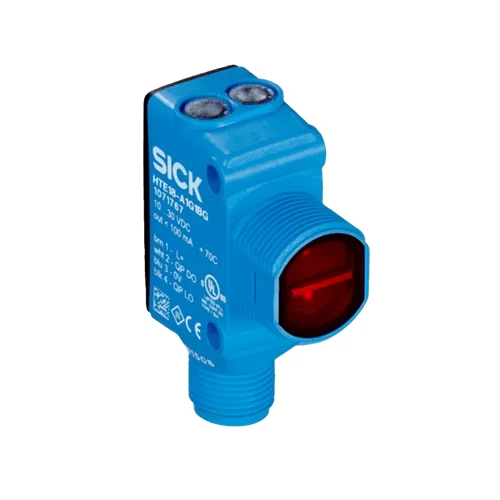
1. Checking component presentation in an assembly fixture
An assembly fixture can present an opaque component at a defined sensing distance and use the Q1 PNP light-switching state as a part-present reference. Background suppression separates the intended target from a more distant background after range adjustment. Setup checks the actual surface and geometry against the 30–250 mm reference-black range, 30–300 mm maximum reference-white range and documented black/white shift curve.
Problem Solved
A locally adjusted target condition gives external assembly sequencing a component-presentation reference, helping distinguish the intended part location from the more distant fixture background.
Fixture presentation
Background suppression
PNP Q1
2. Counting separated small components on a feed track
A feed track can move separated small opaque components through the laser sensing spot and route Q1 PNP transitions to an external counter. The visible red beam and right sensing-range potentiometer assist positioning at the intended passage point. Commissioning assesses target size, remission, spacing and travel speed against the 2 mm spot at 120 mm, 0.5 ms resistive-load response and 1,000 Hz switching specification.
Problem Solved
Repeated laser target transitions provide component-passage events to external counting logic, helping track separated small parts without placing an opposed receiver across the feed track.
Small-part counting
2 mm spot
1,000 Hz
3. Monitoring material retained at a transfer position
A transfer mechanism can place the sensing spot at a position that should clear after an opaque workpiece moves onward. External sequencing starts a timer when the PNP target state appears and compares its duration with the expected transfer interval. The sensor supplies complementary light- and dark-switching conditions, while background suppression limits detection to the adjusted target region rather than the more distant machine structure.
Problem Solved
A sustained target condition gives external transfer logic an occupancy-duration reference, helping identify a workpiece that remains at the monitored position beyond its expected passage interval.
Transfer occupancy
External timing
Complementary outputs