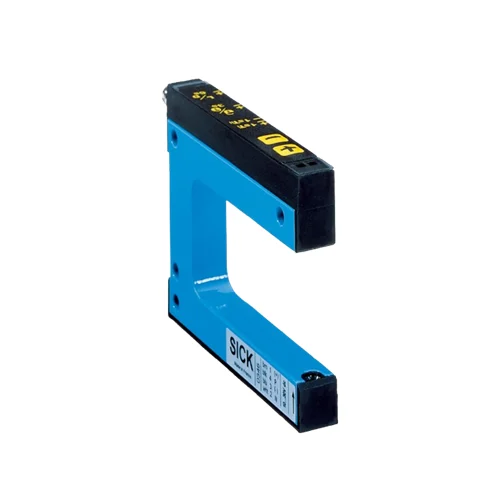
SICK 6033169 WF2-40B416S01 2 mm Teach-in Fork Sensor

USD 212.94

2 mm optical fork with 42 mm depth, 0.2 mm target detection, two-point teaching, separate PNP/NPN outputs, M8 four-pin connector and bottom M5 thread.

SKU SICK-6033169 Category
SICK WF

SICK WF2-40B416S01 2 mm Teach-in Fork Sensor

BrandSICK
Model IdentifierWF2-40B416S01
Official Part Number6033169

Technical Overview

The SICK WF2-40B416S01 is an optical fork sensor with a 2 mm opening, 42 mm fork depth and 0.2 mm minimum detectable object. Two-point teach-in establishes the switching threshold with the machine stopped, followed by optional plus/minus fine adjustment. Separate NPN and PNP outputs connect through an M8 four-pin male connector, with button-selected light/dark operation and a key lock to protect settings. This version adds a bottom fixing hole with an M5 thread to its aluminum housing. Yellow switching-output and red function indicators assist local setup.

2 mm optical fork sensor with two-point teach-in, separate NPN and PNP outputs, M8 four-pin connector and bottom M5 threaded fixing hole.

Key Features

  • Optical fork sensing; 2 mm fork width and 42 mm fork depth
  • 0.2 mm minimum detectable object
  • Two-point teach-in with the machine at a standstill
  • Plus/minus fine threshold adjustment after teaching
  • Separate NPN and PNP outputs; 100 mA output current
  • Button-selected light/dark switching; standard setting light switching
  • Key lock using simultaneous plus/minus button operation
  • M8 four-pin male connector; yellow switching-output and red function indicators
  • Aluminum housing; supply reverse-polarity, output short-circuit and interference-pulse protection
  • Bottom fixing hole with M5 thread

Teach the clear-path and target conditions at standstill, then fine-adjust and lock the optical switching threshold for external material-control inputs.

Technical Specification Matrix

ParameterValue
Functional principleOptical fork detection with opposed sender and receiver
Fork width2 mm
Fork depth42 mm
Minimum detectable object0.2 mm
Teach-in modeTwo-point teach-in
Teach-in procedureMachine stopped: first clear path or substrate, press plus and minus together for 1 s; then object or label in path, press minus for 1 s
Fine adjustmentPlus/minus buttons adjust threshold after teaching; brief press for minor changes, hold for faster adjustment
Key lockPress plus and minus together for 3 s to prevent unintended actuation
Switching modeLight/dark selection by pressing plus and minus together for 6 s; standard setting light switching
Switching outputsSeparate NPN and PNP outputs
Output current100 mA
NPN signal voltageHIGH approximately supply voltage; LOW ≤2 V
Response-time stability±20 µs
Jitter40 µs
ConnectionM8 four-pin male connector
Pin assignmentCD-086: 1 BN=L+; 2 WH=Q NPN; 3 BU=M; 4 BK=Q PNP
Circuit protectionSupply reverse-polarity protection; output Q short-circuit protection; interference pulse suppression
Housing materialAluminum
IndicationYellow switching-output indicator; red function indicator
Mounting holesØ4.2 mm
Shock resistanceEN 60068-2-27
UL fileNRKH.E191603
MTTFD97 years
DCavg0%
Special mounting featureBottom fixing hole with M5 thread

Industrial Applications

1. Counting separated thin opaque flags

A feed mechanism can move separated opaque flags through the 2 mm fork opening and route the selected PNP or NPN output to an external counter. The 0.2 mm minimum detectable object states the small-target capability, while the opposed optical elements are held in one aluminum housing. Setup validates actual motion timing and the external counter input after stationary teaching.

Problem Solved

Individual beam interruptions give external counting logic flag-passage events, helping count separated thin targets using opposed optical elements already aligned within the fork housing.

Thin-flag count 2 mm fork 0.2 mm target

2. Registering opaque label gaps on a carrier web

A labeling mechanism can pass an opaque label web through the fork and use label-to-gap transitions as a reference for external feed control. Two-point teaching samples the substrate and label with the machine stopped, then plus/minus adjustment refines the threshold. Light/dark selection sets the required signal behavior, and the key lock protects the established setting against unintended button operation.

Problem Solved

A taught label-to-substrate optical transition provides an external feed-registration event, helping the labeling controller advance successive opaque labels using the actual material contrast.

Label registration Two-point teach Key lock

3. Monitoring a material edge against a fixed lateral threshold

A web-handling station can locate the optical axis across a fixed edge threshold so lateral material movement blocks or clears the beam. The 42 mm fork depth provides access inward from the material edge, while the 2 mm opening defines the available passage. External guiding logic reads the selected PNP or NPN state after stationary teaching establishes the two optical conditions for the actual material.

Problem Solved

A fixed optical threshold converts lateral edge movement into a switching condition for external guiding logic, helping identify when the web crosses the installed reference.

Web-edge threshold 42 mm depth External guiding

Select your currency