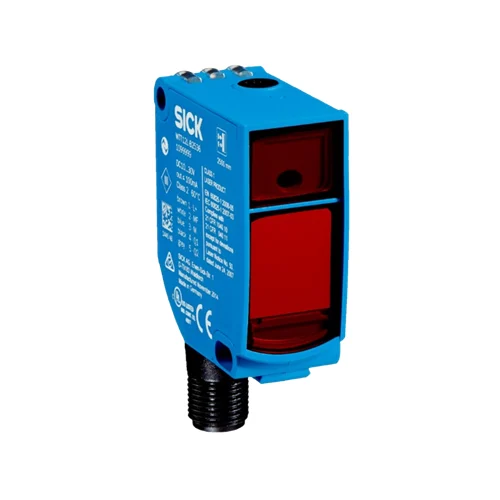
1. Counting separated opaque loads on a conveyor
A conveyor can present separated opaque loads within the adjusted sensing zone and send push-pull transitions to external counting logic. Optical time-of-flight with background suppression separates the presented load from a farther background when the installed geometry provides the required clearance. Commissioning evaluates actual remission, target spacing and speed against the 30 Hz switching rating and 16.7 ms resistive-load response.
Problem Solved
Load-passage transitions give external counting logic a discrete event stream, helping track separated articles from one mounting side while using an adjusted background-suppression zone.
Conveyor counting
30 Hz
Background suppression
2. Confirming a load on a presented carrier
A handling station can present a carrier so that its expected opaque load lies within the adjusted sensing zone and an empty carrier surface remains beyond it. The potentiometer sets the threshold using representative loaded and empty presentations. External inspection logic samples the complementary output condition after motion settles, accounting for remission-dependent background separation and the documented response.
Problem Solved
An adjusted load-present condition helps external inspection logic distinguish a loaded carrier from an empty presentation, supporting an omitted-load check before the next handling operation.
Carrier inspection
Complementary outputs
One distance threshold
3. Checking a sensing channel with controlled sender suppression
During a planned machine check, external control can apply the sender-off input while a representative target remains at a defined position. The controller observes the corresponding switching condition and then releases the input to compare the restored target response. This controlled optical change is coordinated with the machine sequence and evaluated using the documented response and initialization conditions.
Problem Solved
Controlled sender suppression gives maintenance logic an observable optical-state change, helping compare the sensor channel’s output response during a planned check at a defined machine position.
Controlled channel check
Sender-off input
External observation