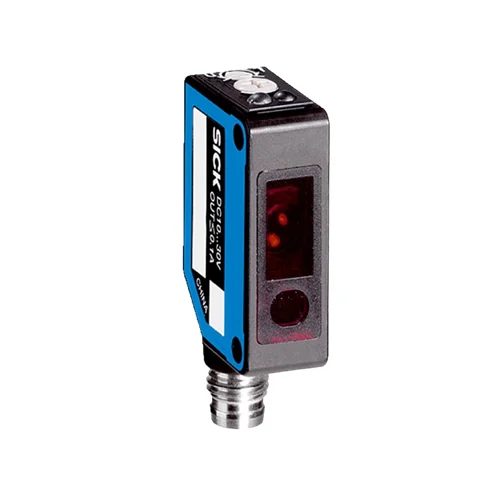
SICK 6033206 WTB8-N2131 NPN Background-Suppression Sensor

USD 136.24

650 nm red LED sensor with 40–300 mm reference-white sensing, NPN light/dark selection, four-turn range adjustment, M8 connection and mounting bracket.

SKU SICK-6033206 Category
SICK W8

SICK WTB8-N2131 NPN Background-Suppression Sensor

BrandSICK
Model IdentifierWTB8-N2131
Official Part Number6033206

Technical Overview

The SICK WTB8-N2131 is a rectangular photoelectric proximity sensor with background suppression and a 650 nm visible red LED. Its main specification table gives a 40–300 mm sensing range and 30–300 mm maximum range on 90% remission reference white. A four-turn potentiometer adjusts sensing distance, while a separate rotary switch selects light or dark operation for the single NPN output. Response is no more than 0.5 ms with a resistive load, and switching frequency is 1,000 Hz at a 1:1 light/dark ratio. Orange output and green stability LEDs assist setup. The ABS housing, PMMA optics, IP67 protection and M8 three-pin connector support installation, with one stainless steel BEF-W100-A bracket supplied.

650 nm red LED background-suppression sensor with 40–300 mm reference-white sensing, single NPN output, four-turn adjustment and M8 three-pin connection.

Key Features

  • Photoelectric proximity sensing with background suppression
  • 40–300 mm sensing; 30–300 mm maximum on 90% reference white
  • 650 nm red LED; Ø20 mm spot at 300 mm
  • Four-turn sensing-range potentiometer
  • Single NPN output; separate light/dark rotary selector
  • ≤0.5 ms resistive-load response; 1,000 Hz at 1:1 light/dark ratio
  • 10–30 V DC; 30 mA without load; output ≤100 mA
  • M8 three-pin connector; M3 threaded mounting holes
  • Orange output and green stability LEDs; one stainless BEF-W100-A bracket
  • ABS housing and PMMA optics; IP67; −25 to +55 °C operation

Adjust the background-suppression distance and observe separate stability and output LEDs when establishing the NPN switching condition for a presented product.

Technical Specification Matrix

ParameterValue
Functional principlePhotoelectric proximity sensing with background suppression
Housing designRectangular
Sensing range40–300 mm on 90% remission reference white, DIN 5033; main specification table
Maximum sensing range30–300 mm on 90% remission reference white, DIN 5033
Light source650 nm visible red LED
Average LED service life100,000 h at +25 °C
Light spot sizeØ20 mm at 300 mm
AdjustmentFour-turn sensing-range potentiometer
Switching outputSingle NPN output
Switching modeLight/dark selectable with rotary switch; L=light, D=dark
Output signal HIGH/LOWApproximately supply voltage / <1.8 V
Output current≤100 mA
Response time≤0.5 ms with resistive load
Switching frequency1,000 Hz at 1:1 light/dark ratio
Power supply10–30 V DC; short-circuit-protected network, maximum 8 A
Ripple±10%; remain within supply-voltage tolerances
Current consumption30 mA without load
ConnectionM8 three-pin male connector
Pin assignmentCD-045: 1 BN=L+; 3 BU=M; 4 BK=Q
Circuit protectionA: supply reverse polarity; B: inputs/output reverse polarity; D: output overcurrent and short circuit
Housing materialABS plastic
Optics materialPMMA plastic
IP ratingIP67
MountingM3 threaded mounting holes; 25.4 mm pitch as drawn
IndicationOrange LED=switching output; green LED=stability
Items suppliedOne BEF-W100-A stainless steel mounting bracket, DIN 1.4301 / AISI 304
Operating temperature−25 to +55 °C
Storage temperature−40 to +70 °C
MTTFD1,568 years
DCavg0%
Physical Weight (kg)0.01

Industrial Applications

1. Counting separated products on a transfer conveyor

A conveyor can present separated products to the red LED sensing zone and send NPN transitions to an external counter. The four-turn potentiometer establishes the sensing distance, and the rotary switch selects light or dark signal behavior. Commissioning considers actual target remission and background position together with product spacing, the ≤0.5 ms response and 1,000 Hz rating.

Problem Solved

Product transitions provide external counting logic with arrival events, helping track separated units when the adjusted optical condition and spacing create distinct switching states.

Product counting NPN output 1,000 Hz

2. Checking a component at a carrier inspection point

An assembly fixture can position a carrier pocket within the sensor’s working distance and present its intended component to the red LED beam. Background suppression supports a component-target arrangement ahead of a more distant background. External inspection logic samples the NPN state after the carrier settles, with setup evaluating actual surface remission and the selected light/dark behavior.

Problem Solved

A component-target switching condition gives external inspection logic a presence reference at the presented pocket, helping identify an empty location before the next operation.

Component inspection Background suppression NPN condition

3. Restoring sensing margin during machine changeover

During a machine changeover, a technician can present a representative product at its normal operating position and adjust the four-turn sensing-range potentiometer. The green stability LED and orange output LED provide separate local observations while the product and background are presented. The external controller then verifies the selected light/dark state through the NPN connection.

Problem Solved

Separate stability and output indications help setup personnel compare the adjusted sensing condition with the switching result, supporting repeatable checks using the representative product.

Changeover setup Stability indication Four-turn adjustment

Select your currency