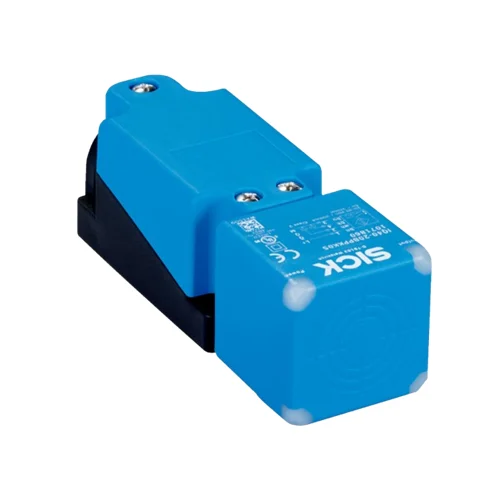
SICK 1071845 IQ40-20BPOKK0S PNP NC Inductive Sensor

USD 61.88

IQ40-20BPOKK0S offers 20 mm nominal inductive sensing, PNP normally-closed output, 150 Hz switching, flush mounting, terminal wiring and IP67/IP68/IP69K.

SKU SICK-1071845 Category
SICK IQG

SICK IQ40-20BPOKK0S PNP NC Inductive Sensor

BrandSICK
Model IdentifierIQ40-20BPOKK0S
Official Part Number1071845

Technical Overview

The SICK IQ40-20BPOKK0S is a rectangular inductive proximity sensor for flush installation, with a 20 mm nominal sensing range and 16.2 mm assured range. Its PNP normally-closed output provides 150 Hz switching for external control logic, with reference reduction factors for different target metals. The 10–30 V DC device uses a cable-gland terminal connection for conductors up to 2.5 mm². Separate yellow output-state and green operational-status LEDs assist local checks. Its PA66 housing and sensing face provide IP67, IP68 and IP69K protection, with operation from −25 to +85 °C. Short-circuit and power-up pulse protection are provided, and continuous output current is no more than 200 mA.

Flush inductive sensor with 20 mm nominal range, PNP normally-closed output, 150 Hz switching and cable-gland terminal connection.

Key Features

  • Rectangular inductive sensor for flush installation
  • 20 mm nominal sensing range; 16.2 mm assured sensing range
  • PNP normally-closed output; DC three-wire wiring
  • 150 Hz switching; continuous output current ≤200 mA
  • Cable-gland terminal connection; wire size ≤2.5 mm²
  • 10–30 V DC; 12.5 mA no-load current
  • Short-circuit and power-up pulse protection
  • Yellow output-state LED and green operational-status LED
  • PA66 housing and sensing face; IP67 / IP68 / IP69K
  • −25 to +85 °C operation; −40 to +85 °C storage

Observe operational status and the target-dependent PNP output separately when tracing metal-position signals through a terminal-wired machine input.

Technical Specification Matrix

ParameterValue
Functional principleInductive proximity sensing
Housing designRectangular, standard design
InstallationFlush
Nominal sensing range Sn20 mm
Assured sensing range Sa16.2 mm
Switching outputPNP normally closed
Electrical wiringDC three-wire
Switching frequency150 Hz
ConnectionCable gland; terminal connection
Gland designationM20 1.5, as specified by manufacturer
Wire size≤2.5 mm²
Terminal assignmentCD-341: 1=L+; 4=not connected; 3=M; 2=NC output
Power supply10–30 V DC
Voltage drop≤2 V
Availability delay≤50 ms
Hysteresis3–15% of Sr
Reproducibility≤2%
Temperature drift±10% of Sr
Continuous output current≤200 mA
No-load current12.5 mA
Circuit protectionShort-circuit protection; power-up pulse protection
Housing materialPA66 plastic
Sensing face materialPA66 plastic
Maximum tightening torque1.8 Nm
IP ratingIP67 / IP68 / IP69K
Operating temperature−25 to +85 °C
Storage temperature−40 to +85 °C
Shock and vibration resistance30 g, 11 ms; 10–55 Hz, 1 mm
Protection classII; reference voltage 50 V DC
UL fileE348498
MTTFD1,125 years
DCavg0%
Mission time20 years
Material reduction factorsReference values, may vary: stainless V2A/304 approximately 0.71; aluminum approximately 0.3; copper approximately 0.25; brass approximately 0.36
Installation diagram clearancesA=0 mm; B=40 mm; C=40 mm; D=60 mm; E=0 mm; F=70 mm; letters refer to manufacturer installation diagram
IndicationYellow LED=output state; green LED=operational status
Mounting holesØ5.5 mm as drawn

Industrial Applications

1. Checking a metal carrier at a transfer stop

A transfer station can present a metal carrier to the flush sensing face and read the PNP normally-closed output after the carrier stops. The 20 mm nominal range and 16.2 mm assured range provide the reference for establishing the installed gap. Setup uses the actual target-metal reduction factor and the manufacturer installation diagram to position the sensor and surrounding hardware.

Problem Solved

A contactless carrier-position reference helps external transfer logic distinguish the presented target condition, supporting sequencing at the stop without a mechanically actuated sensing element.

Carrier position PNP NC Flush mounting

2. Counting separated metal features through a handling station

A handling station can carry separated metal features past the sensing face and feed output transitions to an external counter. The 150 Hz switching rating supports repeated events when target width, spacing, gap and transit speed create distinct states. Commissioning evaluates the actual metal and surrounding mounting geometry rather than treating nominal sensing range as identical for every target.

Problem Solved

Inductive output transitions give external counting logic feature-passage events, helping track repeated metal targets through the handling station using distinct target and gap conditions.

Feature counting 150 Hz Inductive output

3. Distinguishing device operation from output state during maintenance

During a planned maintenance check, a technician can observe the green operational-status LED and yellow output-state LED while a representative metal target is moved into and out of the sensing position. The separate observations help compare device operation with the PNP normally-closed switching condition. External controller input observation then completes the assessment of the installed terminal-wired channel.

Problem Solved

Separate operational and output indicators give maintenance two local observations for tracing a missing machine input, helping distinguish sensor operating condition from the target-dependent switching state.

Local diagnostics Separate LEDs Terminal wiring

Select your currency