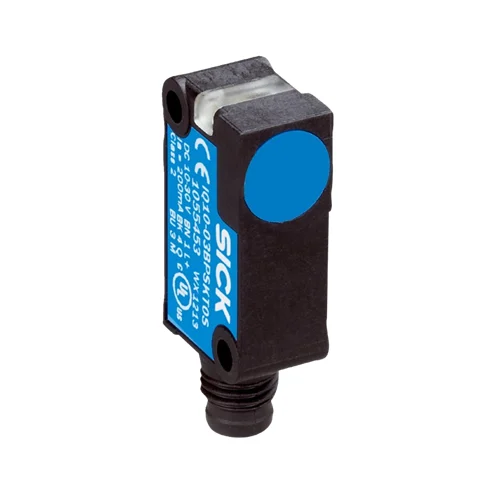
1. Confirming a seated metal component in an assembly fixture
An assembly fixture can present a seated metal component to the flush sensing face and read the PNP normally-open state after the component settles. The 3 mm nominal and 2.43 mm assured sensing ranges provide the gap references. Setup accounts for the actual target metal, reference reduction factors and the manufacturer installation diagram when integrating the rectangular sensor into nearby metalwork.
Problem Solved
A seated-target reference gives external inspection logic a component-present condition, helping distinguish a presented metal part from an empty fixture location before the next assembly operation.
Fixture presence
Flush installation
PNP normally-open
2. Counting separated metal tabs on a moving guide
A moving guide can carry separated metal tabs across the sensing face and supply PNP normally-open transitions to an external counter. The 2,000 Hz rating supports repeated events when tab width, spacing, gap and transit speed allow distinct output intervals. Target-material reduction factors and the flush-installation clearances guide setup for the actual moving hardware.
Problem Solved
Inductive transitions provide external counting logic with tab-passage events, helping track repeated metal features without mechanical contact between the sensor face and moving guide.
Tab counting
2,000 Hz
Inductive transitions
3. Evaluating complementary process signals in external logic
A machine can connect the black normally-open and white normally-closed PNP conductors to separate controller inputs and evaluate their opposed target states. The external program compares the two readings during a defined settled part condition. Its design accounts for the 10–30 V supply, output-current limit and voltage drop when relating the sensor signals to the controller’s input thresholds.
Problem Solved
Complementary target-state signals provide external process logic with two opposed observations, helping identify an unexpected input combination during the machine’s settled inspection condition.
Complementary PNP
Two process inputs
External evaluation