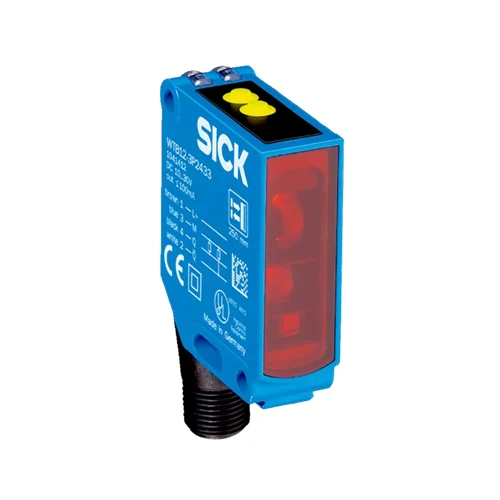
SICK 1041408 WTF12-3N2431 NPN Foreground-Suppression Sensor

USD 243.88

30–175 mm reference-white sensing, complementary NPN outputs, a five-turn potentiometer and M12 connection support background-referenced detection.

SKU SICK-1041408 Category
SICK W12-3

SICK WTF12-3N2431 NPN Foreground-Suppression Sensor

BrandSICK
Model IdentifierWTF12-3N2431
Official Part Number1041408

Technical Overview

The SICK WTF12-3N2431 is a red-LED photoelectric proximity sensor with foreground suppression and a 30–175 mm sensing range, with maximum range specified on standard white. Setup aligns the beam to a background such as a conveyor belt and uses a five-turn potentiometer to distinguish objects entering that path. Two complementary NPN outputs report the detected and undetected conditions to external process control. The device provides 1,500 Hz switching at a 1:1 light/dark ratio and a maximum 330 µs signal transit time with resistive load. Its rectangular metal housing, PMMA front screen and M12 four-pin male connector provide IP66/IP67/IP69K protection for operation from −40 to +60 °C.

Foreground-suppression red-LED sensor with 30–175 mm reference-white range, complementary NPN outputs and M12 four-pin male connector.

Key Features

  • Foreground suppression with setup against a background such as a conveyor belt
  • 30–175 mm sensing range; maximum range referenced to 90% remission standard white
  • 640 nm visible red LED; Ø2 mm at 60 mm
  • Five-turn potentiometer for local sensing adjustment
  • Two complementary NPN outputs with light/dark switching
  • ≤330 µs response with resistive load; 1,500 Hz at a 1:1 light/dark ratio
  • 10–30 V DC; 45 mA consumption without load
  • M12 four-pin male connector; output current ≤100 mA
  • Green supply LED and yellow received-light indicator
  • Metal housing, PMMA front screen and IP66/IP67/IP69K protection

Reference the conveyor background and adjust the foreground-suppression condition locally to give external process logic complementary object-detection signals.

Technical Specification Matrix

ParameterValue
Functional principlePhotoelectric proximity sensor with foreground suppression
Sensing range30–175 mm; maximum range based on 90% remission standard white to DIN 5033
Maximum sensing range30–175 mm on 90% remission standard white to DIN 5033
Light sourceVisible red LED; wavelength 640 nm
Light spot sizeØ2 mm at 60 mm
Average LED service life100,000 h at +25 °C
AdjustmentFive-turn potentiometer
Special applicationDetecting flat objects
Background setupAlign the light spot on the background, then adjust using representative objects; verify object and background reflectance and the manufacturer transition curves
Background indicationYellow LED on with the background received; yellow LED off with a correctly detected intervening object
Digital outputsTwo complementary NPN switching outputs; light/dark switching
Output signal voltageHIGH approximately VS; LOW <2.5 V
Output current≤100 mA
Response time≤330 µs; signal transit time with resistive load
Switching frequency1,500 Hz at a 1:1 light/dark ratio
Power supply10–30 V DC; operate in a short-circuit protected network, maximum 8 A
Ripple<5 Vpp; supply must remain within voltage tolerances
Current consumption45 mA without load
Protection classIII
Circuit protectionA: supply connections reverse-polarity protected; C: interference suppression; D: outputs overcurrent and short-circuit protected
ConnectionM12 four-pin male connector
Pin assignment1 BN=L+; 2 WH=Q̅; 3 BU=M; 4 BK=Q (CD-083)
Output behaviorQ switches for object detected; Q̅ switches for object not detected; switched state is LOW for NPN
HousingRectangular metal housing
Front screenPMMA plastic
MountingM4 threaded mounting hole, 4 mm deep; Ø4.2 mm mounting holes
IndicationGreen LED: supply voltage present; yellow LED: received-light state
Items suppliedTwo BEF-KH-W12 clamps, including screws
IP ratingIP66 / IP67 / IP69K
Operating temperature−40 to +60 °C
Storage temperature−40 to +75 °C
UL file numbersNRKH.E181493 and NRKH7.E181493
MTTFD747 years
DCavg0%
Physical Weight (kg)0.12

Industrial Applications

1. Counting separated pieces on a conveyor

A conveyor station can aim the sensor at a stable belt background and present separated pieces through the beam. Foreground suppression and the locally adjusted optical condition produce a discrete NPN event for external counting logic. Commissioning evaluates actual piece size, reflectance, background distance and spacing against the manufacturer transition curves and the documented response and switching limits.

Problem Solved

A background-referenced passage event lets external counting logic register separated pieces, supporting production totals while the sensor and its optics remain on one mounting side.

Piece counting Background reference 1,500 Hz

2. Monitoring continuity of an opaque strip

A strip-handling station can position an opaque strip between the sensor and a fixed background. With representative strip material and the potentiometer correctly adjusted, strip presence interrupts the received-background condition; a break exposes the background again. External process logic monitors the NPN state to flag an unexpected gap, using the documented yellow indication to establish the two optical conditions during setup.

Problem Solved

A return to the received-background state gives external process logic a strip-break reference, helping identify interrupted material feed at the monitored position.

Strip continuity Gap detection Complementary outputs

3. Detecting prolonged occupancy at a conveyor transfer

A conveyor transfer can use the sensor to monitor whether material remains in the beam beyond the station’s expected transit interval. The complementary outputs provide the occupied and background-visible conditions to external timing logic, which measures dwell and raises a process alarm when configured limits are exceeded. Setup evaluates representative objects, background reflectance and the optical transition curves at the installed distance.

Problem Solved

An externally timed occupancy condition helps the transfer controller identify stalled material instead of treating a persistent detection state as another normal passage event.

Transfer dwell External timer Stalled material

Select your currency