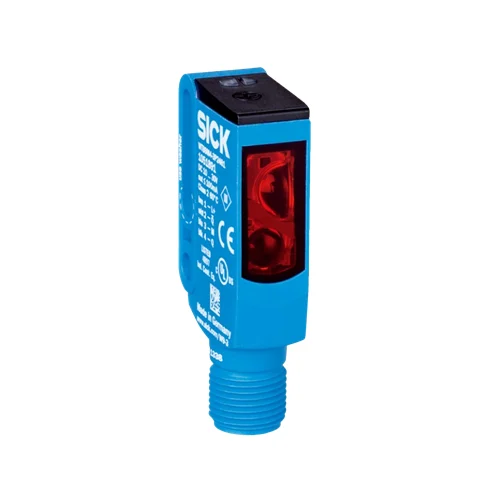
SICK 1051891 WTB9M4-3P2461 PNP Background Suppression Sensor

USD 182.26

WTB9M4-3P2461 offers 20–200 mm sensing on 6% remission targets, complementary PNP outputs, 1,500 Hz operation and an M12 four-pin male connector.

SKU SICK-1051891 Category
SICK W9

SICK WTB9M4-3P2461 PNP Background Suppression Sensor

BrandSICK
Model IdentifierWTB9M4-3P2461
Official Part Number1051891

Technical Overview

The SICK WTB9M4-3P2461 is a photoelectric proximity sensor with background suppression and a 650 nm visible red PinPoint LED. It specifies a 20–200 mm sensing range on 6% remission targets and a 20–350 mm maximum range on 90% remission targets, referenced to DIN 5033 standard white. A five-turn potentiometer adjusts sensing range, while complementary PNP outputs provide light/dark switching with Q assigned to light switching. Response is below 0.333 ms with a resistive load, and switching frequency is 1,500 Hz at a 1:1 light/dark ratio. The 10–30 V DC sensor connects through an M12 four-pin male connector and combines a VISTAL plastic housing, PMMA optics, M4 mounting and IP66/IP67/IP69K protection.

Background suppression sensor with 20–200 mm range on 6% remission targets, complementary PNP outputs, 1,500 Hz switching and M12 four-pin male connector.

Key Features

  • Photoelectric proximity sensing with background suppression
  • 20–200 mm sensing range on 6% remission targets
  • 20–350 mm maximum range on 90% remission targets
  • 650 nm visible red PinPoint LED; Ø4.5 mm at 75 mm
  • Five-turn sensing-range potentiometer
  • Complementary PNP outputs; Q light switching
  • Response <0.333 ms with resistive load; 1,500 Hz at 1:1 light/dark ratio
  • M12 four-pin male connector
  • M4 mounting; VISTAL plastic housing and PMMA optics
  • IP66/IP67/IP69K; −40 to +60 °C operation

Set a distance-based detection zone with a five-turn potentiometer and provide complementary PNP signals for external counting and sequence control.

Technical Specification Matrix

ParameterValue
Functional principlePhotoelectric proximity sensing with background suppression
Housing designRectangular
Mounting holeM4; Ø4.1 mm
Sensing range20–200 mm on a 6% remission target (DIN 5033 standard white reference)
Maximum sensing range20–350 mm on a 90% remission target (DIN 5033 standard white reference)
Gray-target sensing range20–225 mm on 18% remission target
Light source650 nm visible red PinPoint LED
Light-source service lifeAverage 100,000 h at +25 °C
Light spot sizeØ4.5 mm at 75 mm
AdjustmentFive-turn potentiometer for sensing range
Switching outputComplementary PNP outputs Q and Q̅
Switching modeLight/dark switching; Q is light switching
Output current≤100 mA; at and above +50 °C, maximum 50 mA
Response time<0.333 ms with resistive load
Switching frequency1,500 Hz at light/dark ratio 1:1
Power supply10–30 V DC; limit values in a short-circuit-protected network, maximum 8 A
Ripple<5 Vpp; remain within supply-voltage tolerances
Current consumption30 mA without load
ConnectionM12 four-pin male connector
Pin assignment1 BN=L+; 2 WH=Q̅; 3 BU=M; 4 BK=Q (CD-084)
Circuit protectionA: supply connections reverse-polarity protected; B: inputs and output reverse-polarity protected; C: interference suppression
Protection classIII
Housing materialVISTAL plastic
Optics materialPMMA plastic
IP ratingIP66 / IP67 / IP69K
Operating temperature−40 to +60 °C
Storage temperature−40 to +75 °C
IndicatorsYellow: received-light status; green: power on
UL fileNRKH.E181493
MTTFD1,030 years
DCavg0%
Mission time TM20 years
Physical Weight (kg)0.013

Industrial Applications

1. Counting separated cartons on a conveyor

A conveyor can present separated opaque cartons within the verified 20–200 mm range for 6% remission targets. The potentiometer establishes a detection zone ahead of the fixed background, and the complementary PNP outputs supply carton-passage transitions to external counting logic. Commissioning checks carton reflectance, spacing and transit speed against the 1,500 Hz switching specification and actual installation geometry.

Problem Solved

Object-passage transitions help an external counter register separated cartons while background suppression reduces detections from the fixed surface behind the selected working zone.

Carton counting Background suppression 1,500 Hz

2. Detecting a break in an opaque material web

A material guide can hold an opaque web at a repeatable distance in front of a fixed background. The five-turn potentiometer places the web within the detection zone while suppressing the surface farther behind it. External process logic evaluates the complementary PNP states to detect a missing web segment, with actual reflectance and web movement checked during commissioning.

Problem Solved

A web-present condition helps external process logic detect loss of continuous material at the guide before further transport proceeds through the monitored section.

Web continuity Opaque material Complementary outputs

3. Flagging a carton that dwells at a transfer stop

A transfer stop can present an opaque carton inside the adjusted detection zone. External dwell logic starts a timer from the PNP detection transition and compares continued presence with the expected release interval. The sensor supplies a discrete occupied condition rather than an internal timing function, with setup accounting for target reflectance, seated gap and the suppressed background.

Problem Solved

An occupied-position reference lets external dwell logic flag a carton that remains after its release interval, supporting investigation of a blocked transfer location.

Transfer dwell External timer Occupied position

Select your currency