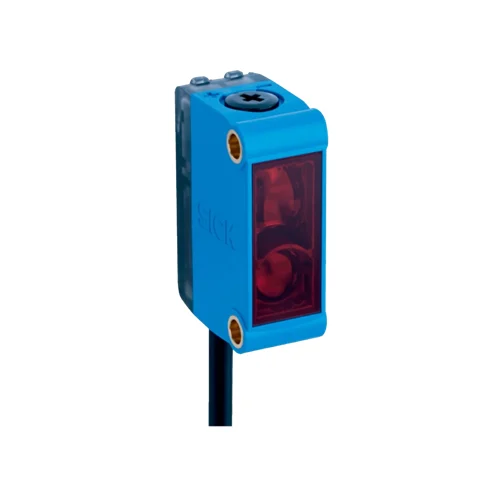
SICK 1069726 GTE6-P1232 PNP Energetic Photoelectric Sensor

USD 67.08

GTE6-P1232 offers 40–760 mm sensing on 90% white targets, a five-turn sensitivity control, PNP output, 500 Hz operation and a 2 m PVC cable.

SKU SICK-1069726 Category
SICK G6

SICK GTE6-P1232 PNP Energetic Photoelectric Sensor

BrandSICK
Model IdentifierGTE6-P1232
Official Part Number1069726

Technical Overview

The SICK GTE6-P1232 is an energetic photoelectric proximity sensor with a 650 nm visible red PinPoint LED and a PNP digital output. Its 40–760 mm sensing range and 30–900 mm maximum range apply to 90% remission white targets, while the specified 6.25% black-target sensing range is 80–190 mm. A five-turn mechanical spindle adjusts sensitivity, and an L/D rotary selector sets light or dark switching. The sensor responds in less than 1.25 ms with a resistive load and switches at 500 Hz with a 1:1 light/dark ratio. It operates from 10–30 V DC through a 2 m three-wire PVC cable, with an IP67 ABS/PC housing, PMMA optics, M3 mounting holes and one supplied stainless steel bracket.

Energetic reflected-light sensor with 40–760 mm white-target range, PNP output, five-turn sensitivity adjustment, 500 Hz switching and a 2 m PVC cable.

Key Features

  • Energetic reflected-light proximity sensing
  • 40–760 mm sensing range on 90% remission white targets
  • 30–900 mm maximum white-target range; 80–190 mm sensing on 6.25% black targets
  • 650 nm visible red PinPoint LED; Ø5 mm spot at 150 mm
  • Five-turn sensitivity spindle and L/D rotary selector
  • PNP digital output; ≤100 mA, reduced to 50 mA above 24 V
  • Response <1.25 ms with resistive load; 500 Hz at 1:1 light/dark ratio
  • 2 m three-wire PVC cable; 0.14 mm² conductors
  • M3 mounting; one BEF-W100-A stainless steel bracket supplied
  • IP67 ABS/PC housing and PMMA optics; −25 to +55 °C operation

Set reflected-light sensitivity with the five-turn spindle and provide a selectable light/dark switching signal from one side of the detection area.

Technical Specification Matrix

ParameterValue
Functional principleEnergetic photoelectric proximity sensing
Sensing range40–760 mm on a 90% remission white target
Maximum sensing range30–900 mm on a 90% remission white target
Black-target sensing range80–190 mm on a 6.25% remission black target; typical maximum range 65–340 mm
Light source650 nm visible red PinPoint LED
Light spot sizeØ5 mm at 150 mm
AdjustmentFive-turn mechanical spindle sensitivity potentiometer
Switching outputPNP digital output
Switching modeLight/dark switching; L/D rotary selector
Output current≤100 mA; at supply voltage >24 V, maximum 50 mA
Response time<1.25 ms with resistive load
Switching frequency500 Hz at light/dark ratio 1:1
Power supply10–30 V DC; limit values in a short-circuit-protected network, maximum 8 A
Ripple±10%; remain within supply-voltage tolerances
Current consumption30 mA without load
Protection classIII
Circuit protectionA: supply connections reverse-polarity protected; B: inputs and output reverse-polarity protected; D: outputs protected against overcurrent and short circuits
ConnectionThree-wire, 2 m PVC cable
Conductor cross-section0.14 mm²
Conductor functionsBN=L+; BU=M; BK=Q (CD-043)
Cable handlingDo not bend below 0 °C
Housing designRectangular
Housing materialABS/PC plastic
Optics materialPMMA plastic
MountingM3 mounting holes; 25.4 mm spacing
Items suppliedOne BEF-W100-A stainless steel mounting bracket, grade 1.4301/304
IP ratingIP67
Operating temperature−25 to +55 °C; temperature stability following adjustment ±10 °C
Storage temperature−40 to +70 °C
IndicatorsGreen: supply voltage on; yellow: received-light status
UL fileNRKH.E348498 and NRKH7.E348498
Signal voltage HIGH/LOWApproximately supply voltage / ≤3 V
MTTFD1,749 years
DCavg0%
Mission time TM20 years
Physical Weight (kg)0.06

Industrial Applications

1. Counting separated cartons on a conveyor

A conveyor can present separated opaque cartons to the sensor from one mounting side. Energetic optics evaluate the returned light, and the five-turn spindle adjusts sensitivity for representative cartons and their background. External counting logic evaluates the PNP transitions using the selected light/dark convention. Commissioning checks actual reflectance, gaps and transit speed against the target-specific ranges and 500 Hz switching specification.

Problem Solved

Carton-passage transitions help an external counter register separated packages from one mounting side, with local sensitivity adjustment for the returned-light conditions at the conveyor.

Carton counting Reflected light 500 Hz

2. Checking an insert in a stationary assembly fixture

An assembly fixture can place an insert at a repeatable distance facing the sensor. The five-turn sensitivity spindle establishes a reflected-light condition using representative assemblies, and external inspection logic samples the digital output while the fixture is stationary. Setup checks insert reflectance and background contrast, accounting for the shorter black-target range rather than assuming that the white-target range applies to every surface.

Problem Solved

A returned-light reference helps external inspection logic distinguish an insert from the empty fixture condition, using local sensitivity adjustment at a repeatable inspection position.

Insert inspection Stationary fixture Sensitivity adjustment

3. Flagging prolonged occupancy at a transfer stop

A transfer stop can hold a defined carton surface in front of the sensor. External dwell logic starts a timer from the detection transition and compares continued occupancy with the expected release interval. The sensor provides the selected light/dark output state rather than an internal timing function. Setup checks actual surface reflectance, settled distance and the background return before the timer is commissioned.

Problem Solved

An occupied-position reference allows external dwell logic to flag a carton remaining beyond its release interval, helping locate a stalled transfer at the monitored stop.

Transfer dwell External timer Light/dark selection

Select your currency