Skip to content

Contact Us:
sales@inosaki.com

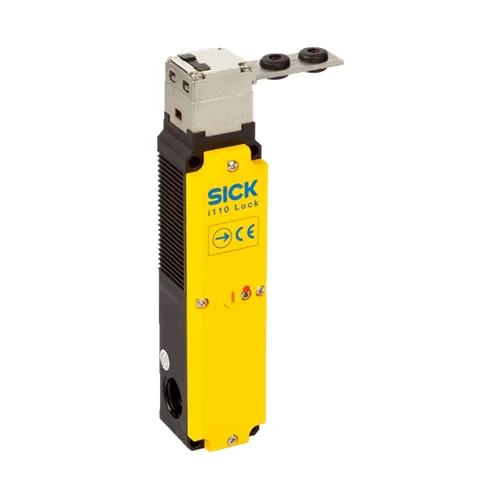
SICK 6051597 i110-E0233 Power-to-Lock Safety Switch

SICK 6051597 i110-E0233 Power-to-Lock Safety Switch

USD 287.82

i110-E0233 provides power-to-lock guard locking, 24 V AC/DC coil operation, separate door and lock contacts, M20 gland entries and IP67.

SKU: SICK-6051597 Category:
SICK Safety Switches

SICK i110-E0233 Power-to-Lock Safety Switch

BrandSICK
Model Identifieri110-E0233
Official Part Number6051597

Technical Overview

The SICK i110-E0233 is an electromechanical safety locking device for a movable guard, using a power-to-lock solenoid. Applying the 24 V AC/DC coil supply locks an inserted actuator; removing that supply unlocks immediately, including on power loss. Two positive-action NC contacts and one NO contact monitor the lock. One ordinary NC door contact separately reports guard position. The device uses three M20 × 1.5 cable-gland entries, a glass-fiber reinforced thermoplastic housing, a metal actuator head and IP67 protection. The coded actuator is supplied separately. Connected safety-related logic performs fault detection and evaluates guard and lock conditions; the switch has no internal fault detection.

Power-to-lock safety switch with 24 V AC/DC solenoid, separate door and lock contacts, three M20 × 1.5 cable-gland entries and IP67 protection.

Key Features

  • i110-E0233 / 6051597: electromechanical power-to-lock safety locking device
  • Lock monitoring: Two positive-action NC contacts and one NO contact
  • Door monitoring: One ordinary NC contact; no positive-action NC or NO door contact
  • 24 V AC/DC solenoid; ≤8 W; 100% magnet duty cycle
  • Removing coil voltage unlocks immediately, including on power loss
  • FZh 2,000 N with straight/radial actuator; 1,150 N with angled actuator
  • Three M20 × 1.5 gland entries; AC-15 4 A at 230 V AC / DC-13 4 A at 24 V DC
  • Type 2 device with low-coded actuator; actuator supplied separately
  • External safety-related logic provides fault detection; no internal fault detection
  • Glass-fiber reinforced thermoplastic housing; metal head; IP67; −20 to +55 °C operation

Coordinate powered guard retention with separate door and lock contact feedback for evaluation by external safety-related logic.

Technical Specification Matrix

ParameterValue
Functional principleElectromechanical safety locking device for a movable guard
Locking principlePower to lock: energize solenoid to lock an inserted actuator; removing coil voltage unlocks immediately, including on power loss
Lock monitoring contactsTwo positive-action NC contacts and one NO contact
Door monitoring contactsOne ordinary NC contact; no positive-action NC or NO door contact
Contact outputElectromechanical contacts; slow-action switching element
Control integrationConnected safety-related logic evaluates guard and lock conditions; guard closure or locking must not automatically restart the machine
Fault detectionNo internal fault detection; the switch cannot assume a safe state on a fault. Fault detection is performed by the connected safety-related logic unit
Solenoid supply24 V AC/DC; +10% / −15%
Power consumption≤8 W
Magnet duty cycle100%
Rated operating currentAC-15: 4 A at 230 V AC; DC-13: 4 A at 24 V DC
Utilization categoryAC-15 / DC-13; IEC 60947-5-1
Rated insulation voltage Ui250 V
Short-circuit protection4 A gG
Pollution degree3
ConnectionThree M20 × 1.5 cable-gland entries
Series connectionNo safe series connection; individual wiring only, with diagnostics
Locking force Fmax2,500 N with straight or radial actuator; 1,500 N with angled actuator; EN ISO 14119
Locking force FZh2,000 N with straight or radial actuator; 1,150 N with angled actuator; EN ISO 14119
Retaining force≤30 N
Actuation frequency≤1,200 per hour
Actuation directions5
Approach speed≤20 m/min
Device typeType 2; EN ISO 14119
Actuator codingLow coding level; EN ISO 14119
Actuator deliveryActuator not supplied with the device
B10d parameter5 × 10^6 switching cycles with small load; operating instructions specify DC-13, 100 mA at 24 V
Mechanical life1 × 10^6 switching cycles
Housing materialGlass-fiber reinforced thermoplastic
Actuator head materialMetal
IP ratingIP67; IEC 60529
Operating temperature−20 to +55 °C
Storage temperature−20 to +55 °C
Conductor cross section0.34–1.5 mm²
Physical Weight (kg)0.5

Industrial Applications

1. Retaining a process access door during a powered production step

A production station can energize the solenoid after its access guard closes, retaining the inserted actuator during a controlled process step. The external controller evaluates the lock contacts and removes coil power at the permitted release point. Because loss of coil voltage unlocks immediately, this power-to-lock behavior must be included in the machine sequence and risk assessment.

Problem Solved

Electrically controlled retention lets the external controller coordinate process access with a production step, using separate lock feedback to distinguish commanded locking from the observed contact state.

Powered retention Lock feedback Controlled process access

2. Separating guard closure from machine restart permission

A machine access sequence can evaluate door-monitoring contacts separately from the positive-action lock-monitoring contacts. The connected safety-related logic checks the required closed and locked conditions before accepting a separate start command. Closing or locking the guard does not itself initiate motion, allowing the machine control to distinguish physical closure from deliberate operator restart.

Problem Solved

Separate door and lock information helps the external control establish the required access conditions before a deliberate restart, avoiding automatic machine starting merely from closing the guard.

Separate restart command Door monitoring Lock monitoring

3. Checking door and lock signals during commissioning and maintenance

During a controlled commissioning or maintenance check, external diagnostic logic can observe door and lock contact states as the guard is closed, the solenoid is energized and the guard is released. Comparing the separate signals with the commanded sequence helps expose an unexpected condition in the installed circuit. Fault detection belongs to the connected safety-related logic, rather than an internal diagnostic function of this switch.

Problem Solved

Independent door and lock observations give external diagnostic logic evidence for identifying a disagreement between commanded operation and the installed contact circuit during a controlled functional check.

Functional checking External diagnostics Separate contact states

Select your currency