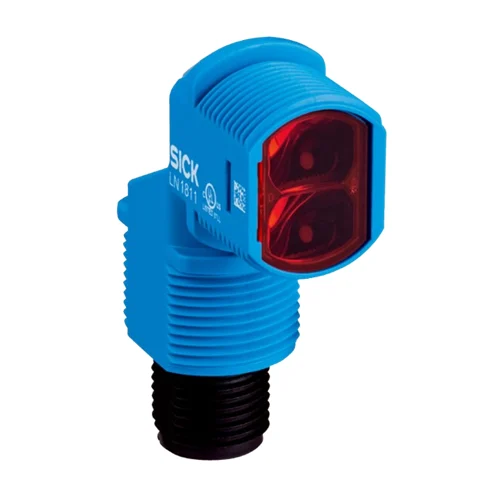
SICK 1099298 ZLD18-4FZ4A8 PNP Dark-Switching Retroreflective Sensor

USD 97.76

ZLD18-4FZ4A8 has a polarized dual-lens design, 625 nm red LED, PNP dark-switching output, 1,000 Hz switching, M12 connection and head/base M18 mounting.

SKU SICK-1099298 Category
SICK Z18 Simple Sense

SICK ZLD18-4FZ4A8 PNP Dark-Switching Retroreflective Sensor

BrandSICK
Model IdentifierZLD18-4FZ4A8
Official Part Number1099298

Technical Overview

The SICK ZLD18-4FZ4A8 is a polarized dual-lens photoelectric retroreflective sensor with a PNP dark-switching output. Its 625 nm visible red LED produces a 125 mm spot at 1 m. The PL80A sensing-range diagram shows operation up to 4.0 m and maximum range up to 5.0 m. Response is no more than 500 µs with a resistive load, with 1,000 Hz switching at a 1:1 light/dark ratio. The blue hybrid ABS housing supports M18 mounting at its head or base, uses PMMA optics and provides IP67 protection. An A-coded M12 four-pin male connector carries 10–30 V DC supply and output Q1, with pin 2 unconnected. Operation spans −40 to +55 °C.

Polarized dual-lens retroreflective sensor with 625 nm LED, PNP dark switching, 1,000 Hz operation and A-coded M12 four-pin connection.

Key Features

  • ZLD18-4FZ4A8 / 1099298: polarized dual-lens retroreflective sensor
  • PL80A sensing-range diagram: operation up to 4.0 m; maximum up to 5.0 m
  • 625 nm visible red LED; Ø125 mm light spot at 1 m
  • Single PNP dark-switching output Q1; Q2 not connected
  • ≤500 µs response with resistive load; 1,000 Hz at 1:1 light/dark ratio
  • 10–30 V DC; ≤15 mA without load; output current 100 mA
  • A-coded M12 four-pin male connector; Q1 on pin 4, pin 2 unconnected
  • Blue hybrid housing; M18 × 1 head/base mounting
  • ABS housing and PMMA optics; polarizing filter
  • IP67; −40 to +55 °C operation; LED status indicator

Use a polarized reflector-return path and a PNP dark-switching signal to provide opaque-object interruption events to external process logic.

Technical Specification Matrix

ParameterValue
Functional principlePolarized photoelectric retroreflective sensing; dual-lens system with minimum distance to reflector
PL80A range diagramSensing operation up to 4.0 m; maximum up to 5.0 m, per manufacturer sensing-range diagram
Other reflector range diagramsSensing / maximum: PL23 FT 1.5 / 1.7 m; PL20A 1.5 / 2.0 m; PL250 2.6 / 3.3 m; PL40A 3.1 / 4.0 m
Light source625 nm visible red LED
Light spot sizeØ125 mm at 1,000 mm
Switching outputSingle PNP output Q1; dark switching; Q2 not connected
Output current100 mA
Response time≤500 µs, signal transit time with resistive load
Switching frequency1,000 Hz with light/dark ratio 1:1
Power supply10–30 V DC
Ripple<10%
Current consumption≤15 mA without load
ConnectionA-coded M12 four-pin male connector
Pin assignment1 BN=L+; 2 WH=not connected; 3 BU=M; 4 BK=Q1
Circuit protectionSupply and input/output reverse-polarity protection; output overcurrent and short-circuit protection
Protection classIII
Housing designHybrid; blue
MountingM18 × 1 at head or base
Housing materialABS plastic
Optics materialPMMA plastic
Polarizing filterYes
Special device designationYes, as identified in manufacturer technical table
IndicationLED status indicator
IP ratingIP67
Operating temperature−40 to +55 °C
Storage temperature−40 to +70 °C
UL fileE189383
Physical Weight (kg)0.00454

Industrial Applications

1. Counting separated opaque cartons on a conveyor

A conveyor can place the sensor on one side of its carton path and a PL80A reflector on the opposite side. Each opaque carton interrupts the polarized return path and produces a PNP dark-switching condition for an external counter. Setup checks carton coverage and spacing against the installed distance, sensing diagram, 1,000 Hz rating and resistive-load response limit.

Problem Solved

Reflector-return interruptions give external counting logic carton-passage events, helping count separated opaque loads while supply and signal wiring remain on the sensor side.

Carton counting PNP dark switching 1,000 Hz

2. Confirming a component crossing a transfer threshold

A transfer station can position the reflector-return path across a location that an opaque component must cross before the next process step. External sequencing logic reads the PNP dark-switching state as a crossing reference. Head or base M18 mounting supports sensor placement, while commissioning checks actual component coverage, alignment and reflector distance against the documented sensing-range diagram.

Problem Solved

A monitored optical crossing gives external sequencing logic a passage reference, helping coordinate the next transfer step when an opaque component interrupts the selected return path.

Transfer crossing Head/base mounting Polarized return

3. Monitoring material that remains across a chute

A parts chute can place the sensor and reflector across a location expected to clear between opaque loads. External timing logic measures the duration of the dark-switching condition and compares it with the process interval. The sensor provides the optical state; the external timer distinguishes a short passage from material that remains across the aligned return path.

Problem Solved

A maintained interruption condition gives external timing logic an accumulation reference, helping identify opaque material that remains at the chute position beyond its expected passage interval.

Chute occupancy External timer Dark-switching output

Select your currency