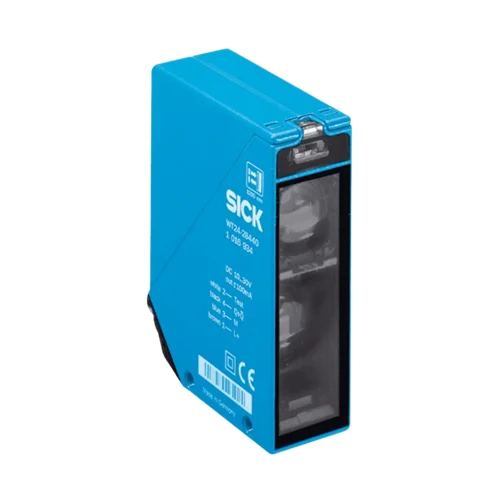
1. Detecting a presented workpiece in front of a machine frame
An assembly station can aim the sensor at an opaque workpiece presented in front of a farther machine structure. Background suppression and potentiometer adjustment establish a foreground sensing boundary for the installed geometry. The output selectors match the required external controller behavior, with setup accounting for the actual target remission rather than applying the reference-white reach to every surface.
Problem Solved
A foreground sensing boundary reduces responses to a farther machine structure, helping sequence control identify when the intended workpiece occupies its presented position.
Foreground workpiece
Background suppression
Adjustable boundary
2. Counting separated raised features on a transport track
A transport track can move separated opaque features across the optical sensing location with the track surface farther behind them. A suitable sensing boundary distinguishes the passing foreground features from that background. External counting electronics interpret the selected output transitions, with the 1,000 Hz rating, 500 µs resistive-load response limit and actual feature spacing guiding the timing assessment.
Problem Solved
Foreground feature passages become electrical count events, helping external transport logic distinguish individual raised targets while suppressing a farther surface behind the sensing point.
Feature counting
1,000 Hz
Selectable output
3. Checking the optical signal path during a maintenance test
During a controlled maintenance check with a target presented, external test logic can connect the TE input to 0 V to switch the sender off. The controller observes the resulting output condition and compares it with the illuminated condition under the selected light/dark logic. This provides a functional check of the ordinary optical signal path using the documented test input.
Problem Solved
The sender-off input creates a deliberate optical-state change for external maintenance logic, helping compare the illuminated and unilluminated output conditions during a controlled functional test.
Sender-off test
TE to 0 V
Maintenance function