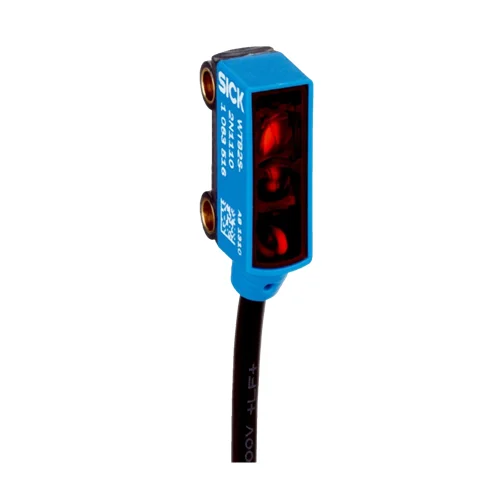
SICK 1064614 WTB2S-2P1145 PNP Teach-in BGS Sensor

USD 159.60

WTB2S-2P1145 offers 10–90 mm reference-white sensing, cable teach-in, a 640 nm PinPoint LED, PNP light switching, 1,000 Hz switching and a 2 m cable.

SKU SICK-1064614 Category
SICK W2

SICK WTB2S-2P1145 PNP Teach-in BGS Sensor

BrandSICK
Model IdentifierWTB2S-2P1145
Official Part Number1064614

Technical Overview

The SICK WTB2S-2P1145 is a miniature photoelectric proximity sensor with background suppression and cable-based teach-in. Its sensing range is 10–90 mm on 90% remission reference white, with a maximum range of 4–110 mm. A visible 640 nm PinPoint LED produces a 4.4 mm light spot at 60 mm. The single PNP light-switching output supports up to 50 mA, with response below 0.5 ms under resistive load and a 1,000 Hz switching rating. A 2 m four-wire PVC cable provides power, output and a separate teach conductor. The IP67 ABS/PC housing uses PMMA optics and operates from −25 to +50 °C.

Miniature background-suppression sensor with 10–90 mm reference-white sensing, cable teach-in, PNP light switching, 1,000 Hz switching and a 2 m four-wire cable.

Key Features

  • Background-suppression photoelectric sensing in a miniature rectangular housing
  • 10–90 mm sensing; 4–110 mm maximum range on 90% remission reference white
  • 640 nm visible red PinPoint LED; Ø4.4 mm spot at 60 mm
  • Sensing adjustment through a separate teach conductor
  • Single PNP light-switching output; output current ≤50 mA
  • Response <0.5 ms with resistive load; 1,000 Hz at 1:1 light/dark ratio
  • 2 m four-wire PVC cable; 0.09 mm² conductors; Ø3 mm cable
  • 10–30 V DC; 20 mA consumption without load
  • ABS/PC housing with PMMA optics; IP67; −25 to +50 °C operation
  • One W2S/G2S screw set supplied; two Ø3.2 mm mounting holes

Teach the optical sensing boundary through a dedicated cable conductor to detect a foreground target from a compact mounting location.

Technical Specification Matrix

ParameterValue
Functional principlePhotoelectric proximity sensor with background suppression
Housing designMiniature rectangular
Sensing range10–90 mm on 90% remission reference white, DIN 5033
Maximum sensing range4–110 mm on 90% remission reference white, DIN 5033
Remission-dependent rangesManufacturer diagram: gray 18% remission 10–90 mm sensing, 5–100 mm maximum; black 6% 10–80 mm sensing, 6–90 mm maximum; ultra-black 1% 15–40 mm sensing, 8–40 mm maximum
Light sourceVisible red PinPoint LED; 640 nm
Average LED service life100,000 h at +25 °C
Light spot sizeØ4.4 mm at 60 mm
AdjustmentCable teach-in through separate teach conductor
Manufacturer special applicationDetecting small objects
Switching outputSingle PNP output
Switching modeLight switching
Output current≤50 mA
Response time<0.5 ms signal transit time with resistive load
Switching frequency1,000 Hz at 1:1 light/dark ratio
Power supply10–30 V DC; limit values
Ripple<5 Vpp; remain within supply-voltage tolerances
Current consumption20 mA without load
Connection2 m four-wire PVC cable; do not bend below 0 °C
Conductor cross-section0.09 mm²
Cable diameterØ3 mm
Conductor functionsCD-093: BN=L+; BU=M; BK=Q; WH=Teach
Circuit protectionSupply reverse-polarity protection; output reverse-polarity protection; output overcurrent and short-circuit protection
Housing materialABS/PC plastic
Optics materialPMMA plastic
IP ratingIP67
Mounting holesTwo Ø3.2 mm holes
Items suppliedOne SCREW SET W2S/G2S
IndicationGreen LED: supply voltage; yellow LED: received light
Operating temperature−25 to +50 °C
Storage temperature−40 to +75 °C
UL fileNRKH.E181493
MTTFD1,547 years
DCavg0%

Industrial Applications

1. Establishing a foreground target condition during fixture setup

An assembly fixture can present its intended opaque component while setup logic operates the separate teach conductor. Cable-based adjustment establishes the background-suppression sensing condition without a local range potentiometer. During the process, external sequence logic reads the PNP light-switching state, with commissioning verifying the actual target surface and its distance from the farther fixture structure.

Problem Solved

The separate teach conductor supports setting the foreground sensing condition from the machine wiring location, helping prepare a compact fixture for its intended component presentation.

Cable teach-in Foreground setup PNP output

2. Counting separated opaque components on a narrow track

A narrow transport track can bring separated opaque components through the red sensing location with a farther surface behind them. Background suppression distinguishes foreground passages under the installed geometry. External counting electronics use output transitions and assess speed against the 1,000 Hz switching rating and response below 0.5 ms, while setup verifies target coverage, remission and separation.

Problem Solved

Foreground passages become discrete electrical count events, helping external transport logic count separated components while suppressing a suitably spaced surface behind the sensing location.

Component counting 1,000 Hz Background suppression

3. Monitoring opaque material at a replenishment threshold

A feeder can aim the sensor at opaque material occupying a defined location near its outlet. Cable teach-in adjusts the sensing condition for the presented material and background, and the single PNP signal reports local occupancy. External logic evaluates a sustained absence condition before requesting replenishment, with the working distance selected for the actual target remission.

Problem Solved

A sustained change at the monitored material threshold gives external feeder logic a replenishment reference, helping detect when the expected foreground material no longer occupies the sensing location.

Material replenishment Cable adjustment Sustained absence

Select your currency