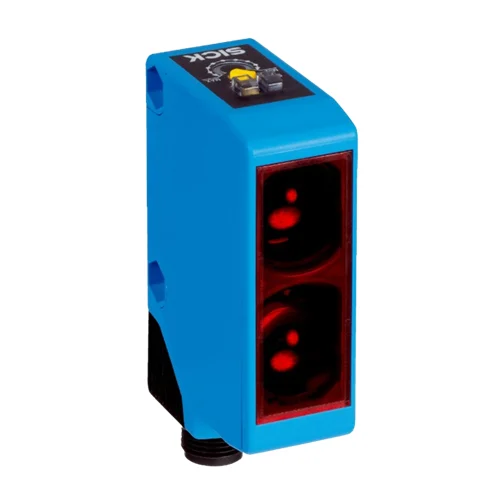
SICK 6044675 WTB250-2P2431 PNP BGS Photoelectric Sensor

USD 208.00

WTB250-2P2431 provides 100–300 mm reference-white background-suppression sensing, PNP output, two-turn range adjustment, an M12 connector and IP67.

SKU SICK-6044675 Category
SICK W250-2

SICK WTB250-2P2431 PNP BGS Photoelectric Sensor

BrandSICK
Model IdentifierWTB250-2P2431
Official Part Number6044675

Technical Overview

The SICK WTB250-2P2431 is a rectangular photoelectric proximity sensor with background suppression and visible red LED illumination. Its sensing and maximum sensing ranges are both 100–300 mm on 90% remission reference white, with a 30 mm light spot at 300 mm. A two-turn potentiometer with position indication adjusts sensing range. The single PNP output supports light or dark switching selected through the L/D control connection. Response is no greater than 3 ms with resistive load, with a 160 Hz switching rating. A four-pin M12 male connector rotates through 90°, while the ABS housing and PMMA optics provide IP67 protection. A BEF-W250 mounting bracket is supplied.

Red LED background-suppression sensor with 100–300 mm reference-white sensing, PNP output, two-turn range adjustment and rotatable four-pin M12 connector.

Key Features

  • Background-suppression photoelectric proximity sensing from one mounting side
  • 100–300 mm sensing and maximum sensing range on 90% remission reference white
  • Visible red LED; Ø30 mm light spot at 300 mm; approximately 3° dispersion
  • Two-turn sensing-range potentiometer with position indicator
  • Single PNP output; light/dark switching selected through L/D control connection
  • Response ≤3 ms with resistive load; 160 Hz at 1:1 light/dark ratio
  • M12 four-pin male connector, rotatable through 90°
  • 10–30 V DC; 35 mA consumption without load; output current ≤100 mA
  • ABS housing with PMMA optics; IP67; −25 to +55 °C operation
  • BEF-W250 mounting bracket supplied; green stability and yellow received-light indicators

Set a foreground sensing boundary with the two-turn adjustment and connect its switching signal through a rotatable M12 connector.

Technical Specification Matrix

ParameterValue
Functional principlePhotoelectric proximity sensor with background suppression
Housing designRectangular
Sensing range100–300 mm on 90% remission reference white, DIN 5033
Maximum sensing range100–300 mm on 90% remission reference white, DIN 5033
Remission-dependent sensing rangesManufacturer diagram against white background: black 6% remission 100–240 mm; gray 18% remission 100–300 mm
Light sourceVisible red LED
Average LED service life100,000 h at +25 °C
Light spot sizeØ30 mm at 300 mm
Manufacturer focus specificationApproximately 3°
Angle of dispersionApproximately 3°
AdjustmentTwo-turn sensing-range potentiometer with position indicator
Sensitivity position indicatorManufacturer drawing shows 270° indication
Switching outputSingle PNP output
Switching modeLight/dark switching selected through L/D control connection
Output current≤100 mA
Response time≤3 ms signal transit time with resistive load
Switching frequency160 Hz with 1:1 light/dark ratio
ConnectionM12 four-pin male connector; position rotatable through 90°
Connector positionsVertical or horizontal end position; horizontal position lockable with slider
Pin assignmentCD-087: 1 BN=L+; 2 WH=L/D; 3 BU=M; 4 BK=Q
Power supply10–30 V DC; short-circuit-protected network, maximum 8 A
Ripple<5 Vpp; remain within supply-voltage tolerances
Current consumption35 mA without load
Circuit protectionSupply reverse-polarity protection; input and output reverse-polarity protection; interference suppression; output overcurrent and short-circuit protection
Protection classIII
Housing materialABS plastic
Optics materialPMMA plastic
IP ratingIP67
Items suppliedBEF-W250 mounting bracket
Mounting holesØ4.2 mm; for M4 hexagon nuts on both sides
IndicationGreen LED: stability; yellow LED: received-light status
EMCEN 60947-5-2
Operating temperature−25 to +55 °C
Storage temperature−40 to +70 °C
UL filesNRKH2.E300503 and NRKH8.E300503
MTTFD516 years
DCavg0%
Physical Weight (kg)0.04

Industrial Applications

1. Confirming a workpiece presented in front of a fixture

An assembly station can aim the red sensing spot at an opaque workpiece presented before a farther fixture structure. The two-turn potentiometer sets the background-suppression sensing boundary for that geometry. External sequencing logic reads the selected light/dark output condition, with setup accounting for target remission and the working range rather than applying the reference-white limit to every surface.

Problem Solved

An adjustable foreground sensing boundary reduces responses to a farther fixture surface, helping external sequence control identify when the intended workpiece occupies its presented position.

Foreground workpiece Background suppression Two-turn adjustment

2. Counting separated opaque articles on a conveyor

A conveyor can carry separated opaque articles through the red optical sensing location while a farther surface remains beyond the selected boundary. Each passage creates an output transition for external counting electronics. The 160 Hz switching rating and response no greater than 3 ms with resistive load provide timing references, while commissioning verifies article coverage, remission and spacing.

Problem Solved

Foreground article passages become electrical count events for external transport logic, helping track separated loads with one-sided optical mounting and a defined sensing boundary.

Article counting 160 Hz One-sided optics

3. Monitoring material at a fixed feeder threshold

A parts feeder can present opaque material at a fixed optical threshold and monitor whether that location remains occupied. The potentiometer sets the foreground sensing condition, and the L/D control connection selects the required output behavior. External logic times a sustained empty condition before requesting replenishment, with actual material remission and background separation verified during setup.

Problem Solved

A sustained change at the selected material threshold gives external feeder logic a replenishment reference, helping identify when the expected foreground material no longer occupies that location.

Feeder threshold Light/dark control Sustained absence

Select your currency