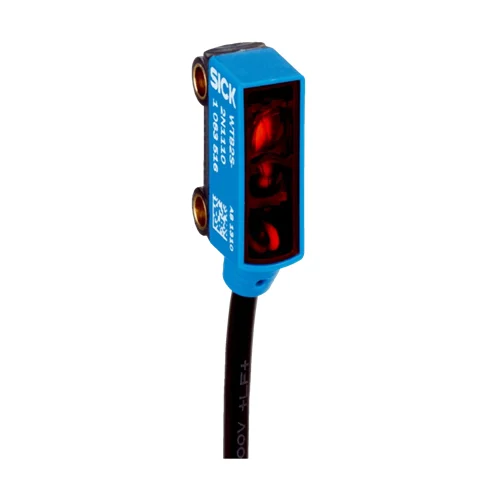
SICK 1064593 WL2S-2F3130 PNP Retro-reflective Sensor

USD 96.46

WL2S-2F3130 offers 0–0.55 m sensing with P250F, polarized 640 nm PinPoint LED optics, PNP dark switching, 1,000 Hz operation and an M8 pigtail.

SKU SICK-1064593 Category
SICK W2

SICK WL2S-2F3130 PNP Retro-reflective Sensor

BrandSICK
Model IdentifierWL2S-2F3130
Official Part Number1064593

Technical Overview

The SICK WL2S-2F3130 is a miniature retro-reflective photoelectric sensor with autocollimation/coaxial optics and a polarizing filter. Its specified sensing range is 0–0.55 m with a P250F reflector, while maximum range is separately rated 0–1.2 m. Visible 640 nm PinPoint LED illumination produces a 12 mm spot at 250 mm, and the optics have no specified reflector minimum distance. A single PNP output uses fixed dark switching, with no local sensitivity adjustment. Response is below 0.5 ms with resistive load, with a 1,000 Hz switching rating. The 10–30 V DC device connects through a 200 mm PVC cable with three-pin M8 connector; its ABS/PC housing and PMMA optics provide IP67 protection.

Polarized retro-reflective sensor with 0–0.55 m P250F sensing range, fixed PNP dark switching and 200 mm PVC cable with three-pin M8 connector.

Key Features

  • Retro-reflective autocollimation/coaxial optics without reflector minimum distance
  • 0–0.55 m sensing range with P250F reflector; 0–1.2 m maximum range
  • Polarizing filter and visible 640 nm red PinPoint LED
  • Ø12 mm light spot at 250 mm; average LED service life 100,000 h at +25 °C
  • Single PNP output with fixed dark switching; no sensitivity adjustment
  • Response <0.5 ms with resistive load; 1,000 Hz switching at 1:1 light/dark ratio
  • 200 mm PVC cable with three-pin M8 connector
  • 10–30 V DC; 20 mA consumption without load; output current ≤50 mA
  • ABS/PC housing and PMMA optics; IP67; −25 to +50 °C operation
  • Two Ø3.2 mm mounting holes; green power and yellow received-light indicators

Detect opaque objects interrupting a defined reflector path with polarized coaxial optics and a PNP signal for external machine control.

Technical Specification Matrix

ParameterValue
Functional principlePhotoelectric retro-reflective sensor
Optical arrangementAutocollimation/coaxial optics; without reflector minimum distance
Housing designRectangular
Sensing range0–0.55 m with P250F reflector
Maximum sensing range0–1.2 m with P250F reflector
Other reflector rangesSensing / maximum: PL20F 0–750 / 0–1,000 mm; REF-AC1000 reflective tape 0–400 / 0–750 mm; PL10F 0–300 / 0–600 mm; PL8FH 0–150 / 0–250 mm
Light sourceVisible red PinPoint LED
Wavelength640 nm
Average LED service life100,000 h at +25 °C
Light spot sizeØ12 mm at 250 mm
Polarizing filterPresent
AdjustmentNone
Switching outputSingle PNP output
Switching modeDark switching
Response time<0.5 ms signal transit time with resistive load
Switching frequency1,000 Hz with 1:1 light/dark ratio
Output current≤50 mA
Power supply10–30 V DC
Ripple<5 Vpp; remain within supply-voltage tolerances
Current consumption20 mA without load
Connection200 mm PVC cable with three-pin M8 connector
Pin assignmentCD-045: 1 BN=L+; 3 BU=M; 4 BK=Q
Cable materialPVC plastic; do not bend below 0 °C
Conductor cross-section0.09 mm²
Cable diameterØ3 mm
Circuit protectionSupply reverse-polarity protection; output reverse-polarity protection; output overcurrent and short-circuit protection
Housing materialABS/PC plastic
Optics materialPMMA plastic
IP ratingIP67
Mounting holesTwo Ø3.2 mm holes
IndicationGreen LED: supply power; yellow LED: received-light status
Operating temperature−25 to +50 °C
Storage temperature−40 to +75 °C
UL fileNRKH.E181493
MTTFD4,863 years
DCavg0%

Industrial Applications

1. Counting separated opaque articles across a conveyor

A conveyor can carry separated opaque articles through a beam established between the sensor and a facing reflector. Each interruption produces an output transition for an external counter. Autocollimation removes a specified reflector minimum distance, while setup keeps the P250F reflector within the 0–0.55 m sensing range and checks article coverage and spacing against the documented timing limits.

Problem Solved

Beam interruptions provide individual passage events to external counting electronics, helping track separated opaque articles without relying on light returned from their surfaces.

Opaque article counting Retro-reflective optics 1,000 Hz

2. Monitoring continuity of an opaque strip at a guide

A strip-handling machine can place the sensor and reflector on opposite sides of an opaque material guide. The strip normally interrupts the beam, and a break or missing section changes the received-light condition. External logic evaluates the PNP switching signal after threading, with the guide constraining strip motion so normal lateral movement remains within the beam coverage.

Problem Solved

A change from continuous beam blockage gives external strip-handling logic a material-continuity indication, helping identify a broken or missing opaque strip at the monitored guide.

Strip continuity PNP signal Fixed optical path

3. Timing persistent occupancy at a transfer point

A transfer station can position a reflector across a monitored lane and use the sensor to indicate when an opaque load occupies that optical path. External transfer logic times a sustained interruption rather than treating every brief passage as accumulation. The green power and yellow received-light indicators assist setup, with the installed reflector distance and load coverage kept within the documented optical conditions.

Problem Solved

A sustained beam interruption supplies external transfer logic with an occupancy-duration reference, helping distinguish a load remaining at the transfer point from normal short passages.

Transfer occupancy External timing Received-light indication

Select your currency