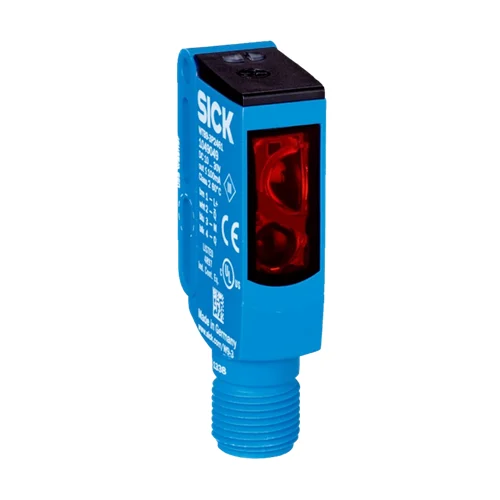
SICK 1049048 WTB9-3P2411 Infrared PNP BGS Sensor

USD 125.84

WTB9-3P2411 offers 20–250 mm sensing on 6% remission targets, 850 nm infrared light, five-turn adjustment, complementary PNP outputs and an M12 connector.

SKU SICK-1049048 Category
SICK W9

SICK WTB9-3P2411 Infrared PNP BGS Sensor

BrandSICK
Model IdentifierWTB9-3P2411
Official Part Number1049048

Technical Overview

The SICK WTB9-3P2411 is an infrared photoelectric proximity sensor with background suppression. Its specified sensing range is 20–250 mm on a 6% remission target, while maximum range is 20–500 mm on 90% remission reference white. An 850 nm LED produces a 20 mm spot at 250 mm, and a five-turn potentiometer adjusts the sensing boundary. Complementary PNP outputs provide light/dark switching, with Q defined as light switching. Response is below 0.5 ms with resistive load, with a 1,000 Hz switching rating. The 10–30 V DC device has a four-pin M12 male connector, M3 mounting holes, VISTAL housing, PMMA optics and IP66/IP67/IP69K protection.

850 nm background-suppression sensor with five-turn range adjustment, complementary PNP outputs, 1,000 Hz switching and four-pin M12 connector.

Key Features

  • Background-suppression photoelectric proximity sensing from one mounting side
  • 20–250 mm sensing on 6% remission targets; 20–500 mm maximum on 90% reference white
  • 850 nm infrared LED; Ø20 mm light spot at 250 mm
  • Five-turn sensing-range potentiometer
  • Complementary PNP outputs; Q is light switching and inverse Q is dark switching
  • Response <0.5 ms with resistive load; 1,000 Hz at 1:1 light/dark ratio
  • M12 four-pin male connector; M3 mounting holes
  • 10–30 V DC; 30 mA consumption without load; maximum load 50 mA at ≥+50 °C
  • VISTAL plastic housing and PMMA optics; IP66/IP67/IP69K
  • −40 to +60 °C operation; green power and yellow received-light indicators

Set a foreground boundary with the five-turn potentiometer and use complementary PNP signals to monitor opaque targets against a farther background.

Technical Specification Matrix

ParameterValue
Functional principlePhotoelectric proximity sensor with background suppression
Housing designRectangular
Sensing range20–250 mm on 6% remission target, relative to DIN 5033 reference white
Maximum sensing range20–500 mm on 90% remission reference white, DIN 5033
Remission-dependent sensing rangesManufacturer diagram: black 6% 20–250 mm; gray 18% 20–375 mm; white 90% 20–500 mm
Light sourceInfrared LED
Wavelength850 nm
Average LED service life100,000 h at +25 °C
Light spot sizeØ20 mm at 250 mm
Additional light spot sizesØ8 mm at 100 mm; Ø30 mm at 350 mm; Ø55 mm at 500 mm
AdjustmentFive-turn sensing-range potentiometer
Switching outputComplementary PNP outputs Q and inverse Q
Switching modeLight/dark switching; Q is light switching
Output current≤100 mA; at ambient temperature ≥+50 °C, maximum load current is 50 mA
Response time<0.5 ms signal transit time with resistive load
Switching frequency1,000 Hz with 1:1 light/dark ratio
Power supply10–30 V DC in short-circuit-protected network, maximum 8 A
Ripple<5 Vpp; remain within supply-voltage tolerances
Current consumption30 mA without load
ConnectionM12 four-pin male connector
Pin assignmentCD-084: 1 BN=L+; 2 WH=inverse Q; 3 BU=M; 4 BK=Q
Circuit protectionSupply reverse-polarity protection; inputs and output reverse-polarity protection; interference suppression
Protection classIII
Housing materialVISTAL® plastic
Optics materialPMMA plastic
IP ratingIP66 / IP67 / IP69K
MountingM3 mounting holes; Ø3.1 mm in manufacturer drawing
IndicationYellow LED: received-light status; green LED: power on
Operating temperature−40 to +60 °C
Storage temperature−40 to +75 °C
UL fileNRKH.E181493
MTTFD896 years
DCavg0%
Mission time20 years
Physical Weight (kg)0.013

Industrial Applications

1. Checking a workpiece presented before a fixture background

An assembly station can present an opaque workpiece at a repeatable gap before a farther fixture surface. The five-turn potentiometer sets the background-suppression sensing boundary for that geometry. External inspection logic reads the complementary PNP conditions after the part settles, with setup using the 20–250 mm rating for a 6% remission target and accounting for the actual background separation.

Problem Solved

A foreground sensing boundary helps external inspection logic distinguish a presented workpiece from the farther fixture background, supporting an ordinary part-presence check before assembly continues.

Foreground workpiece Background suppression Five-turn adjustment

2. Counting separated opaque parts through a transfer guide

A transfer guide can move separated opaque parts past the infrared sensing location while keeping a farther structure beyond the selected foreground boundary. Each part passage produces transitions for external counting electronics. The 1,000 Hz rating and response below 0.5 ms with resistive load provide timing references, while commissioning verifies part coverage, spacing and the remission-dependent working distance.

Problem Solved

Foreground part passages provide discrete count events to external transport logic, helping track separated loads with the optical components installed on one side of the guide.

Part counting 1,000 Hz One-sided sensing

3. Monitoring material at a feeder replenishment threshold

A parts feeder can present opaque material at a fixed sensing threshold and monitor whether that location remains occupied. The potentiometer sets the foreground boundary, and complementary PNP outputs provide both signal conditions to external logic. The controller times a sustained empty condition before requesting replenishment, with the installed distance selected for the actual material remission and background geometry.

Problem Solved

A persistent change at the foreground threshold gives external feeder logic a replenishment reference, helping identify when expected material no longer occupies the monitored location.

Feeder threshold Complementary PNP Sustained absence

Select your currency