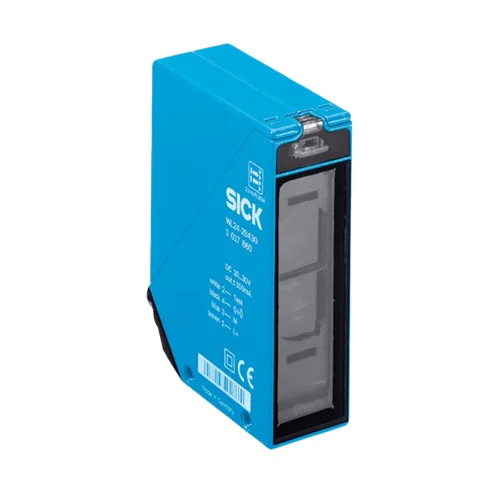
SICK 1018025 WL24-2V540 Timed Retro-reflective Sensor

USD 202.80

WL24-2V540 combines polarized reflector sensing to 15 m on PL80A, selectable PNP/NPN output, 0.5–10 s delays, an alarm output and an M12 five-pin plug.

SKU SICK-1018025 Category
SICK W24-2

SICK WL24-2V540 Timed Retro-reflective Sensor

BrandSICK
Model IdentifierWL24-2V540
Official Part Number1018025

Technical Overview

The SICK WL24-2V540 is a polarized dual-lens photoelectric retro-reflective sensor with visible red LED light. Its PL80A reflector diagram specifies 0.03–15 m sensing and 0.03–22 m maximum range. A potentiometer adjusts sensitivity, while separate selectors choose PNP or NPN output and light or dark switching. The device provides an alarm output and a sender-off test input, with a stated response of no more than 500 µs under resistive load and 1,000 Hz at a 1:1 light/dark ratio. Selectable on/off delays span 0.5–10 s; static low-output front-screen heating is specified for +5 to +15 °C. The zinc die-cast housing uses PMMA optics, M12 five-pin plug and IP69K protection.

Polarized red-LED retro-reflective sensor with PL80A sensing to 15 m, selectable PNP/NPN output, alarm output and M12 five-pin plug.

Key Features

  • Polarized dual-lens retro-reflective sensing with visible red LED
  • PL80A diagram: 0.03–15 m sensing; 0.03–22 m maximum range
  • Ø250 mm light spot at 15 m; sensitivity potentiometer
  • Selectable PNP or NPN output; separate light/dark selector
  • Alarm output; sender-off test input TE to 0 V
  • ≤500 µs resistive-load response; 1,000 Hz at 1:1 light/dark ratio
  • 10–30 V DC; output current ≤100 mA
  • M12 five-pin plug; M5 threaded mounting holes
  • Zinc die-cast housing; PMMA optics; IP69K; −40 to +60 °C operation
  • 0.5–10 s on/off delays; static low-output screen heater for +5 to +15 °C

Select PNP/NPN and light/dark behavior locally and use adjustable on/off delays to qualify the reflector-path signal for the machine sequence.

Technical Specification Matrix

ParameterValue
Functional principlePhotoelectric retro-reflective sensing; dual-lens optics
Polarization filterYes
Sensing range0.03–15 m with PL80A, from exact sensing-range diagram
Maximum sensing range0.03–22 m with PL80A, from exact sensing-range diagram
Other reflector rangesPL50A and PL40A: 0.03–11 m sensing, 0.03–16 m maximum; PL30A and PL20A: 0.03–7 m sensing, 0.03–10 m maximum
Reflective tape rangeDiamond Grade: 0.03–7 m sensing; 0.03–10 m maximum
C110A reflector range0.15–10 m sensing; 0.15–13 m maximum
Light sourceVisible red LED
Average LED service life100,000 h at +25 °C
Light spot sizeØ250 mm at 15 m
AdjustmentSensitivity potentiometer
Switching outputSelectable PNP or NPN; output current ≤100 mA
Switching modeLight/dark switching; separate selector
Alarm outputYes; dedicated alarm output
Test inputTE to 0 V switches sender off
Response time≤500 µs signal transit time with resistive load
Switching frequency1,000 Hz at 1:1 light/dark ratio
ConnectionM12 five-pin plug
Wiring assignmentCD-150: 1 BN=L+; 2 WH=Test; 3 BU=M; 4 BK=Q/Q̅ selected light/dark output; 5 GY=Alarm
Power supply10–30 V DC; short-circuit-protected network, maximum 8 A
Ripple<5 Vpp; remain within supply-voltage tolerances
Current consumption50 mA without load
Circuit protectionSupply reverse-polarity protection; interference suppression; output overcurrent and short-circuit protection
Protection classII; reference voltage 50 V DC
Housing designRectangular
Housing materialZinc die-cast metal
Optics materialPMMA plastic
IP ratingIP69K
MountingM5 threaded mounting holes: 6 mm-deep hole and through-hole shown in drawing
Indication and alignmentLED signal-strength indicator; alignment sight
Operating temperature−40 to +60 °C
Storage temperature−40 to +75 °C
MTTFD588 years
DCavg0%
UL fileNRKH.E181493 and NRKH7.E181493
Time functionsSwitch-on delay and off delay
Delay setting0.5–10 s; time delay selector with separate t1 on-delay and t2 off-delay controls
Front-screen heatingPermanent static low heat output; use at +5 to +15 °C; PMMA front screen
Mission time20 years
Physical Weight (kg)0.33

Industrial Applications

1. Counting separated loads crossing a reflector path

A conveyor can carry separated opaque loads through a red-light path between the sensor and a suitable reflector. The sensitivity potentiometer and local PNP/NPN and light/dark selectors establish the signal expected by the external counter. Setup checks load coverage, reflector range, spacing and speed against the 1,000 Hz and resistive-load response specifications. Time delays are disabled for direct passage counting.

Problem Solved

A beam-interruption event gives external counting logic a load-passage reference across the conveyor, with selectable electrical behavior matching the installed control input and counting sequence.

Load counter Reflector path Selectable output

2. Qualifying a sustained obstruction before changing a machine sequence

A machine can arrange the sensor and reflector across a material path and select the appropriate light/dark condition for sustained obstruction. The 0.5–10 s on-delay qualifies the selected condition before the switching output changes. External sequencing logic receives that delayed signal, with setup checking actual interruption duration and deliberately including the configured delay in process timing.

Problem Solved

A configurable delay helps external sequencing logic distinguish a sustained selected optical condition from a brief interruption, reducing unwanted process changes caused by shorter events.

On-delay qualification Sustained condition Process sequence

3. Holding a transfer signal through short optical gaps

A transfer station can use the selected optical condition as a process signal and apply the 0.5–10 s off-delay to hold that output through shorter gaps. Separate t2 and time-selector controls set the intended retention behavior. Commissioning verifies the chosen light/dark mode, gap duration and full sequence timing so that retained output does not obscure a condition that the machine must detect immediately.

Problem Solved

A configured off-delay helps external transfer logic maintain its selected process signal across brief optical gaps, avoiding repeated sequence changes when the intended condition remains established.

Off-delay hold Transfer signal Gap filtering

Select your currency