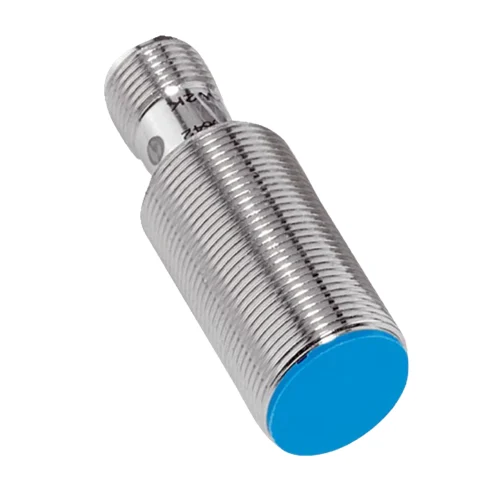
SICK 1040933 IME18-05BPSZC0K 5 mm PNP Inductive Sensor

USD 31.20

IME18-05BPSZC0K offers 5 mm nominal and 4.05 mm assured inductive sensing, flush M18 mounting, PNP normally-open output, 1,000 Hz switching and M12 connection.

SKU SICK-1040933 Category
SICK IME

SICK IME18-05BPSZC0K 5 mm PNP Inductive Sensor

BrandSICK
Model IdentifierIME18-05BPSZC0K
Official Part Number1040933

Technical Overview

The SICK IME18-05BPSZC0K is a short-body M18 × 1 inductive proximity sensor for flush installation in metal. Its nominal sensing range is 5 mm and assured range is 4.05 mm, with material-dependent reduction factors for non-reference targets. The PNP normally-open output uses DC three-wire wiring and switches at 1,000 Hz. A nickel-plated brass housing and PA 66 plastic sensing face provide IP67 protection, and two nickel-plated brass mounting nuts are supplied. The 50 mm housing has 33 mm of mounting thread and connects through an M12 four-pin male connector. Supply spans 10–30 V DC, with continuous output current up to 200 mA, short-circuit and power-up pulse protection, and operation from −25 to +75 °C.

Flush M18 short-body inductive sensor with 5 mm nominal range, 4.05 mm assured range, PNP normally-open output and M12 four-pin male connector.

Key Features

  • M18 × 1 short-body inductive sensor for flush metal installation
  • 5 mm nominal sensing range Sn; 4.05 mm assured range Sa
  • Single PNP normally-open output with DC three-wire wiring
  • 1,000 Hz switching frequency; ≤100 ms delay before availability
  • 10–30 V DC; ≤200 mA continuous output current; ≤10 mA no-load current
  • ≤2 V voltage drop at maximum output current; 5–15% hysteresis
  • Short-circuit protection and power-up pulse protection
  • M12 four-pin male connector; 50 mm housing extent and 33 mm thread
  • Nickel-plated brass housing, PA 66 face and two nickel-plated brass nuts
  • IP67 to EN 60529; −25 to +75 °C operating temperature

Detect nearby metal from a flush M18 mounting position and deliver a PNP normally-open signal to external sequencing or counting logic.

Technical Specification Matrix

ParameterValue
Functional principleInductive proximity sensing
Housing designShort-body
Mounting threadM18 × 1; nominal housing diameter 18 mm
InstallationFlush in metal
Nominal sensing range Sn5 mm
Assured sensing range Sa4.05 mm
Material reduction factorsReference values, may vary: St37 steel 1; V2A/304 stainless steel approximately 0.8; aluminum approximately 0.45; copper approximately 0.4; brass approximately 0.4
Switching outputSingle PNP, normally open
Electrical wiringDC three-wire
Switching frequency1,000 Hz
Power supply10–30 V DC
Ripple≤10%
Voltage drop≤2 V at maximum output current
Delay before availability≤100 ms
Hysteresis5–15%
Reproducibility≤2% of Sr at constant supply voltage and ambient temperature
Temperature drift±10% of Sr
Continuous output current≤200 mA
No-load current≤10 mA
Short-circuit protectionProvided
Power-up pulse protectionProvided
ConnectionM12 four-pin male connector
Connection assignmentCD-007: 1 BN=L+; 4 BK=normally-open output; 3 BU=M; pin 2 not connected
Housing axial extent50 mm in manufacturer drawing; includes integral connector
Thread length33 mm
Maximum tightening torque≤40 Nm
Items suppliedTwo nickel-plated brass mounting nuts; 24 mm across flats in drawing
IndicatorDisplay LED shown in manufacturer drawing
Housing materialNickel-plated brass
Sensing-face materialPA 66 plastic
IP ratingIP67, EN 60529
Operating temperature−25 to +75 °C
Shock resistance30 g, 11 ms
Vibration resistance10–55 Hz, 1 mm
EMCEN 60947-5-2
UL fileNRKH.E181493
MTTFD1,735 years
DCavg0%
Flush-installation clearancesB=18 mm; C=18 mm; D=15 mm; F=40 mm, as labeled in manufacturer installation graphic

Industrial Applications

1. Confirming a metal clamp at its seated position

A fixture can present a metal clamp target to the flush sensing face when the clamp reaches its seated position. External sequencing logic reads the PNP normally-open state as a position condition. The commissioned gap accounts for the 4.05 mm assured range and target-material reduction factors, while flush installation places the sensing face alongside the surrounding metal mounting surface.

Problem Solved

A seated metal-target condition helps external sequencing logic distinguish the intended clamp position from an open presentation, providing contactless position feedback at the fixture.

Clamp position Flush M18 PNP normally open

2. Counting separated metal features on a rotating mechanism

A rotating mechanism can carry separated metal tabs past the fixed inductive sensing face and route PNP transitions to an external counter. The 1,000 Hz switching rating defines the sensor frequency basis. Installation preserves the documented clearances, and commissioning checks actual tab material, face coverage, gap and separation so that successive features produce distinct target-present and target-absent intervals.

Problem Solved

Distinct inductive transitions give external counting logic a reference for passing metal features, helping track mechanism cycles without optical dependence on the target color.

Metal-feature counting 1,000 Hz Inductive transitions

3. Checking a metal insert in an assembly pocket

An assembly pocket can present a metal insert close to the sensing face while an empty pocket leaves the immediate detection area clear. External inspection logic samples the normally-open output after loading settles. Commissioning uses representative inserts and the material reduction factors, with the 5 mm nominal and 4.05 mm assured ranges distinguished when setting the repeatable inspection gap.

Problem Solved

A local metal-present condition helps external inspection logic identify an omitted insert before the next assembly step, using inductive sensing at the expected pocket location.

Insert inspection Metal presence Material factors

Select your currency