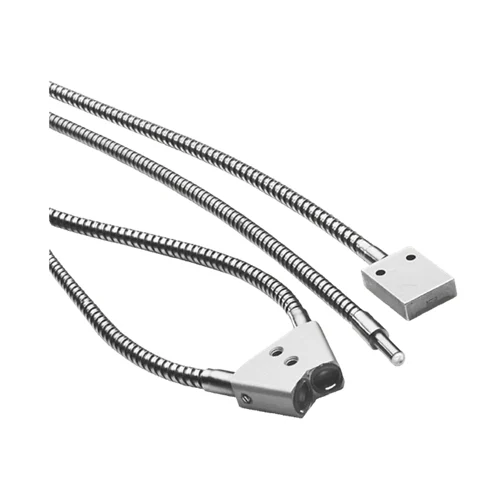
1. Counting separated hot parts across a transfer path
A hot-part transfer can mount two optical fibers on opposite sides of the path and connect them to a compatible WLL260 amplifier. Each sufficiently opaque part interrupts the through-beam light path, and external counting logic evaluates the amplifier’s switching events. The LISAT32900 fiber end and stainless jacket are selected within the documented fiber temperature range; amplifier location, gap and event timing are established separately.
Problem Solved
Remote optical heads provide a passage reference near the hot transfer, allowing the compatible amplifier electronics to occupy a separate location while external logic counts interrupted-beam events.
Hot-part passage
Through-beam
Remote amplifier
2. Monitoring continuity of an opaque strip
A strip feeder can position the paired optical heads so the expected opaque material blocks the through-beam path. A break restores light reception at the WLL260 amplifier, and external feeder logic evaluates the sustained state change. The 900 mm fiber length and angled threaded head guide the installation layout, while routing respects the specified 19 mm bend radius.
Problem Solved
A sustained change in through-beam reception gives external feeder logic a strip-loss reference, supporting recognition of a broken or exhausted opaque material feed.
Strip continuity
Angled head
19 mm bend radius
3. Recognizing a blocked transfer throat
A transfer throat can place the paired optical heads across the expected clearance path and use a compatible WLL260 amplifier to evaluate received light. External process control times how long a load interrupts the beam and compares that condition with the normal clearing sequence. The threaded angled head supports the selected mounting orientation, with actual target opacity, optical separation and amplifier timing established during commissioning.
Problem Solved
A persistent interrupted-beam condition gives external transfer logic an occupancy reference, helping recognize material that remains in the throat after the expected clearing movement.
Transfer occupancy
External dwell timing
Threaded head