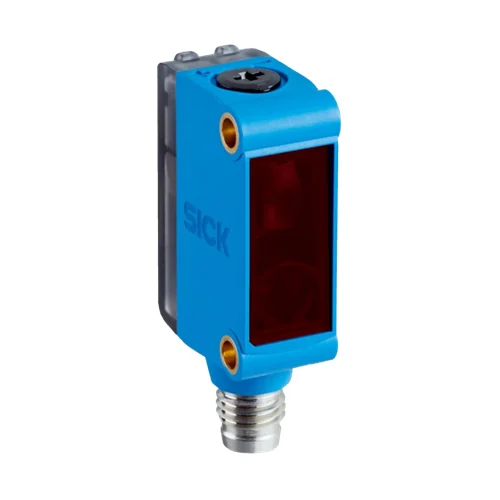
1. Checking a presented component against a distant background
An assembly fixture can present a component within the 35–140 mm sensing zone and set the background-suppression condition with the five-turn spindle. External inspection logic samples a PNP output after the part settles. Setup establishes the actual target and background separation using representative reflectance, while the M3 holes hold the selected optical position and the LED indicates received-light status.
Problem Solved
An adjusted target-zone condition gives external inspection logic a component-present reference, helping distinguish an omitted part from the expected settled assembly presentation.
Component inspection
Background suppression
Five-turn adjustment
2. Counting separated tabs on a moving carrier
A moving carrier can bring separated opaque tabs through the adjusted sensing zone and route PNP transitions to an external counter. The 1,000 Hz switching rating and response below 625 µs provide the sensor timing basis. Commissioning establishes tab coverage, spacing and input timing, with both the electrical load and the supply-dependent 50 mA limit respected when supply exceeds 24 V.
Problem Solved
Distinct tab-passage transitions give external counting logic a carrier-event reference, supporting cycle tracking through a compact sensor positioned on one side of the moving path.
Tab counting
1,000 Hz
PNP transitions
3. Comparing complementary states during fixture diagnostics
A fixture can connect Q and complementary Q̅ to separate ordinary machine inputs while the sensor monitors normal part presentation. External maintenance logic compares the settled states with the expected complementary relationship and prompts inspection when they disagree. Sampling accounts for sensor response and input timing, while the actual pin assignment and load limits define the two connected signal paths.
Problem Solved
Complementary signal paths provide external maintenance logic with a consistency check on the reported optical condition and connected inputs, helping investigate an unexpected fixture indication.
Complementary signals
Fixture diagnostics
Two input paths