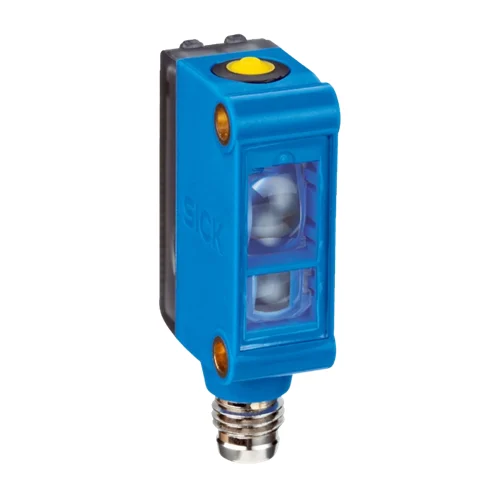
SICK 1072473 KTM-MP11181P PNP White-LED Contrast Sensor

USD 195.00

White-LED contrast sensor with a vertical 1.5 ×6.5 mm spot, PNP light/dark output, 15 kHz switching, dynamic external teaching and M8 connection.

SKU SICK-1072473 Category
SICK KTM Core

SICK KTM-MP11181P PNP White-LED Contrast Sensor

BrandSICK
Model IdentifierKTM-MP11181P
Official Part Number1072473

Technical Overview

The SICK KTM-MP11181P is a compact white-LED contrast sensor emitting from the long side of its housing. It forms a 1.5 ×6.5 mm spot oriented vertically relative to the long housing side, with a sensing distance of ≤12.5 mm and ±3 mm tolerance. A local button supports static or dynamic two-point teaching and proximity-to-mark threshold adjustment; the ET input supports dynamic teaching. Static light/dark behavior follows the teaching sequence, while dynamic teaching activates the output on the mark when the background occupies the longer portion of the teaching interval. The PNP output combines 15 kHz switching at a 1:1 light/dark ratio, 32 µs response and 15 µs jitter. An uncoded M8 four-pin connector, ABS housing, PMMA optics and IP67 protection support compact machine installation.

White-LED contrast sensor with 1.5 ×6.5 mm spot oriented vertically relative to the long housing side, PNP output, static/dynamic teaching, 15 kHz switching and M8 four-pin connection.

Key Features

  • White-LED contrast detection; light emission from long housing side
  • 1.5 ×6.5 mm spot oriented vertically relative to the long housing side
  • Sensing distance ≤12.5 mm; tolerance ±3 mm
  • Local static/dynamic two-point teaching; proximity-to-mark threshold adjustment
  • External dynamic teaching through ET input; 28 ms retention, non-volatile memory
  • PNP light/dark output; 50 mA maximum total output current
  • 15 kHz at 1:1 light/dark ratio; 32 µs response; 15 µs jitter
  • 12–24 V DC nominal; −10%/+20% tolerances; <50 mA without load
  • Uncoded M8 four-pin male connector; local teach button and key lock
  • ABS housing; PMMA optics; IP67; −10 to +55 °C operation

Teach the contrast between a mark and its background, then send a fast PNP switching event to external registration or inspection control.

Technical Specification Matrix

ParameterValue
Functional principleOptical contrast sensing
Housing designSmall
Light sourceWhite LED; average service life 100,000 h at +25 °C
Light emissionLong side of housing
Light spot1.5 ×6.5 mm; vertical relative to long housing side
Receiving filterNone
Sensing distance≤12.5 mm
Distance tolerance±3 mm
AdjustmentTeach-in button
Teach-in modesTwo-point static/dynamic; proximity to mark; ET supports dynamic teach-in
Static teaching sequencePosition mark; hold button >1 s and <3 s; position background; press <3 s
Dynamic teaching sequenceMove at least mark and background through spot while holding button >3 s and <30 s; release button
Switching behaviorStatic: light/dark defined by teaching sequence. Dynamic: active on mark when background is longer in teaching field; threshold centered between mark and background
Proximity-to-mark thresholdA further button press >20 ms and <10 s within 10 s after teaching sets relative threshold to 75% between background (0%) and mark (100%)
Key lockHold teach-in button >30 s to activate/deactivate
Teach failure indicationYellow LED and emitted light flash quickly; during external dynamic teaching, 5 Hz feedback via Q
Switching outputPNP; light/dark switching
Output current50 mA maximum total current of all outputs
Switching frequency15 kHz at 1:1 light/dark ratio
Response time32 µs
Jitter15 µs
External teach inputTeach: 10.8 V ≤U < supply voltage; Run: U <2 V or open
ET retention28 ms; non-volatile memory
Time delayNone
Power supplyNominal 12–24 V DC; −10% at 12 V to +20% at 24 V; short-circuit-protected network maximum 8 A
Ripple≤5 Vpp; remain within supply tolerances
Current consumption<50 mA without load
Circuit protectionSupply reverse-polarity protection; output Q short-circuit protection; interference pulse suppression
Protection classIII
ConnectionUncoded M8 four-pin male connector
Pin assignment1 BN=L+; 2 WH=ET; 3 BU=M; 4 BK=Q
Housing materialABS
Optics materialPMMA
MountingM3 holes; 25.4 mm center spacing in drawing
Body partial sizes12 mm width ×31.5 mm body height ×21 mm depth; connector and raised controls are separate projections
IndicatorsGreen: power on; yellow: switching output Q
IP ratingIP67
Operating temperature−10 to +55 °C
Storage temperature−20 to +75 °C
Shock loadIEC 60068
UL filesNRKH.E348498 and NRKH7.E348498
Physical Weight (kg)0.02

Industrial Applications

1. Registering a printed mark on a moving web

A web machine can pass a recurring printed mark and its background through the white-light sensing spot. Static or dynamic teaching establishes the contrast threshold, and the PNP transition provides an event for external registration control. Commissioning checks mark width and orientation, web speed and distance against the documented spot geometry, response, jitter and working-distance tolerance.

Problem Solved

A taught mark-to-background transition gives external registration control a repeatable optical event, supporting coordination of a downstream operation with the printed material’s actual passage.

Web registration White light PNP event

2. Checking a contrast patch on an indexed component

An assembly fixture can present an expected contrasting patch at a fixed viewing point after the component settles. Two-point static teaching uses the patch and surrounding surface to establish the threshold. External inspection logic samples the PNP condition within its inspection window, with placement and surface finish commissioned against the specified spot and distance tolerance.

Problem Solved

A taught patch condition gives external inspection logic an appearance-based reference, helping identify a missing or differently presented patch at the indexed inspection point.

Patch inspection Static teaching Indexed fixture

3. Teaching a new mark dynamically during recipe changeover

A machine changeover can present a new printed material and use the ET input to initiate dynamic teaching while mark and background cross the spot. The background occupies the longer portion of that teaching presentation, establishing the documented active-on-mark behavior. External control supplies the teach and run levels, allows the retention interval and evaluates the teaching feedback before the normal sequence resumes.

Problem Solved

External dynamic teaching lets machine changeover logic establish a threshold for the new mark and background, reducing repeated local button access during supported material changes.

Recipe changeover External dynamic teach Non-volatile setting

Select your currency