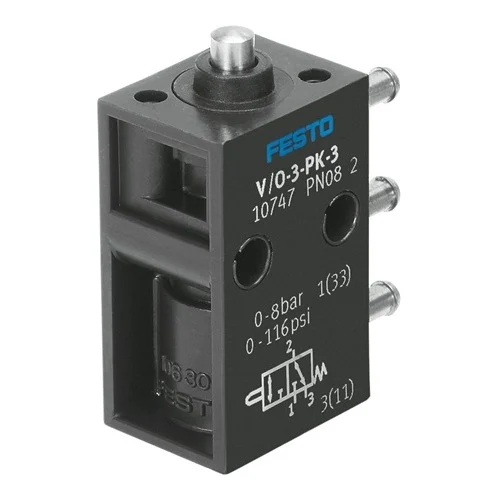
1. Non-Electric End-of-Stroke Sensing in Explosive Environments
In volatile chemical processing environments (ATEX zones) where electrical sparks pose a severe explosion risk, this valve acts as a mechanical limit switch for a pneumatic linear actuator. Mounted at the extension limit of a conveyor diverter cylinder, the moving carriage physically strikes the valve's stem.
Problem SolvedEliminates the need for expensive explosion-proof electrical sensors. The mechanical actuation (17 N force) ensures reliable physical contact detection without electricity. The 3/2-way monostable function instantly sends a pneumatic pilot signal (using the 80 l/min flow rate) to a master control valve to reverse the cylinder, creating a fully safe, spark-free automation loop.
ATEX Zone SafetyPneumatic LogicLimit SwitchMechanical ActuationPilot Signal
2. Safety Interlock for Pneumatic Press Guards
Installed within the frame of a safety guard door on a small pneumatic assembly press. The valve is positioned so that the door's hinge or edge depresses the stem only when fully closed. This creates a 'permissive' pneumatic signal required for the machine's start circuit to function.
Problem SolvedPrevents machine operation if the guard is open, protecting operators from injury. The normally closed configuration (via PK-3 ports) vents the pilot pressure immediately if the door opens, engaging the machine's safety stop. The robust Piston Seat design and POM housing allow it to withstand repetitive door cycling (up to 8 bar pressure) without failure.
Safety InterlockMachine GuardingNormally ClosedPneumatic PermissiveRisk Mitigation
3. Cam-Driven Sequential Automation for Rotary Tables
Used in a purely pneumatic rotary indexing table for parts assembly. A central camshaft rotates, with lobes designed to depress the valve stem at specific degrees of rotation. The valve triggers the next step in the sequence (e.g., extending a clamp or air blast) by sending a pilot signal through 3mm tubing.
Problem SolvedEnables complex automation sequences without a PLC or solenoid valves. The compact 2.5mm nominal size and PK-3 barbed connections allow for tight grouping of multiple valves around a single cam. The 80 l/min flow is sufficient to pilot larger directional control valves, synchronizing mechanical motion perfectly with the pneumatic control.
Cam FollowerSequential ControlRotary IndexingPilot ValveAutomation Timing