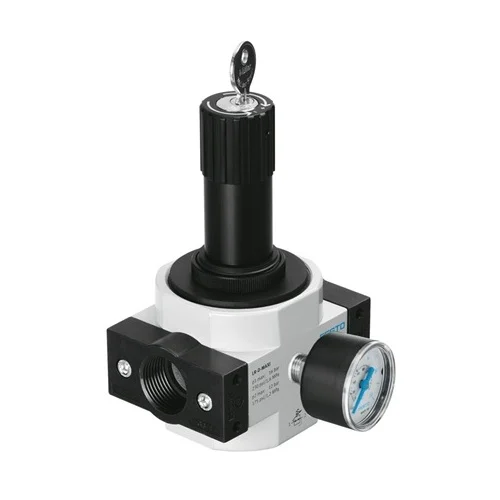
1. Tamper-Proof Workholding Pressure Control in CNC Machining Centers
Implementation of the Festo LRS-3/8-D-MIDI as the primary pressure supply regulator for pneumatic vices and fixture clamps within a CNC milling cell. The regulator is installed at the machine's pneumatic entry panel to step down the main shop air (10-12 bar) to a precise, calculated clamping pressure (e.g., 5.5 bar) required for holding sensitive aluminum components.
Problem SolvedPrevents part deformation and scrap caused by operators arbitrarily increasing clamping pressure. Standard regulators allow unauthorized adjustments, leading to crushed parts or, conversely, insufficient holding force (slippage). The LRS's integrated rotary lock physically secures the optimal pressure setting, ensuring consistent clamping force across production shifts.
Rotary knob with integrated lock0.2 bar hysteresisG3/8 pneumatic connectionSecondary ventingSecure clamping force
2. Air Supply Distribution for Automotive Assembly Torque Tools
Deployed as the point-of-use regulator for pneumatic nut runners and impact wrenches on an automotive final assembly line. The regulator manages the air supply for a multi-tool station, ensuring that the dynamic pressure remains stable even when multiple tools are triggered simultaneously.
Problem SolvedEliminates torque inaccuracies caused by pressure sag during high-demand bursts. Pneumatic torque tools require a specific, stable inlet pressure to meet ISO quality standards. The 3200 l/min flow rate provides ample headroom for concurrent tool usage, while the lockable feature prevents line workers from bypassing torque limits by cranking up the pressure.
Standard nominal flow rate 3200 l/minOperating pressure 0-16 barFlow dynamicsTorque complianceDie-cast zinc housing
3. Actuator Control in High-Speed Packaging Case Erectors
Integration into the pneumatic circuit of a corrugated box forming machine (case erector). The regulator controls the force of the flap-folding cylinders. Because these machines operate at high speeds (up to 60 cases/minute), the cylinders generate significant back pressure during retraction.
Problem SolvedResolves pressure spikes and inconsistent cylinder speed caused by rapid cycling. The LRS-3/8-D-MIDI's 'secondary venting' feature actively exhausts excess back pressure from the actuator circuit, maintaining a constant output pressure despite the mechanical load pushing back on the system. This ensures uniform folding force and prevents machine jams.
Secondary ventingOutput pressure constantDirectly actuated diaphragm regulatorRapid cyclingCRC 2 Corrosion resistance