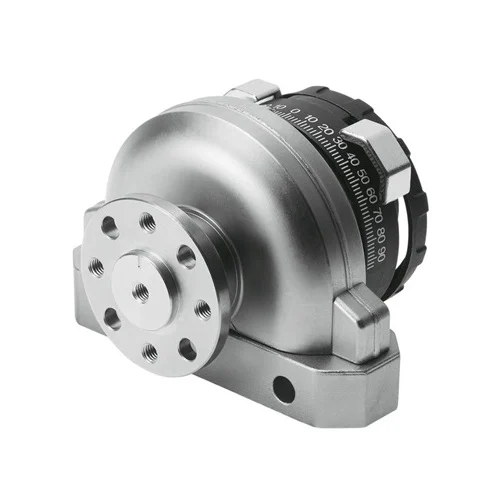
1. Rotary Vacuum Gripper for Electronics Pick-and-Place
Integration into End-of-Arm Tooling (EOAT) on a delta robot to rotate small electronic components (e.g., microchips or smartphone lenses) by 180 degrees for proper alignment before placement on a PCB.
Problem SolvedEliminates external tubing tangling and fatigue failures during rapid rotation. The 'FW' hollow flanged shaft specification allows the vacuum line to be fed directly through the center of the actuator to the suction cup, while the 1 Nm torque safely handles the low-inertia payload of the gripper and chip.
Hollow flanged shaft (FW)End-of-Arm Tooling (EOAT)Vacuum feed-through1 Nm torqueElectronics assembly
2. High-Speed Reject Diverter for Miniaturized Conveyors
Actuation of a lightweight sorting gate or paddle on a compact belt conveyor to divert defective small parts (like pharmaceutical vials or fasteners) into a rejection bin.
Problem SolvedEnables sorting in highly space-constrained machinery where standard cylinders are too bulky. The actuator's high switching frequency of 3 Hz allows it to keep up with rapid production rates, and the 180-degree rotation range creates a complete clear/block state for the divert path.
3 Hz switching frequencySorting/DivertingSize 12 compact footprintDouble-acting operation0...180 deg swivel angle
3. Automated Test Tube Inversion in Clinical Analyzers
A mechanism within a desktop laboratory analyzer that clamps a test tube and rotates it 180 degrees to mix reagents or dump washing fluid into a waste trough.
Problem SolvedAutomates manual mixing tasks in a compact footprint. The elastic cushioning (P) at both ends prevents shock damage to glass vials during the hard stops of the 180-degree turn, while the nickel-plated steel shaft ensures durability against potential chemical splashes in the lab environment.
Laboratory automation180 degree inversionElastic cushioning (P)Sample preparationNickel-plated shaft