1. AutomatedOpticalInspection(AOI)forHigh-DensityPCBs
IntegrationintocompactAutomatedOpticalInspectionsystemsforfactoryautomationtoverifysolderjointintegrityanddetectmicro-defectsondenselypopulatedprintedcircuitboards[1.3].
Problem SolvedDetecting microscopic soldering defects on tight PCB assembly lines requires high spatial resolution without optical distortion. The lens's 6.00 MP resolution and 2.2 µm minimal pixel size allow for precise sub-millimeter defect detection. Additionally, its narrow 14.08° angle of view and 0.2 m minimal object distance (M.O.D.) provide a highly magnified, distortion-free view of extremely small surface-mount electronic components.
6.00 MP Resolution2.2 µm Minimal Pixel Size14.08° Angle of View0.2 m M.O.D.
2. Low-Light Biomedical Microplate Analysis
Employed in automated biomedical instrumentation to capture high-resolution images of assay microplates and cellular cultures in confined laboratory environments.
Problem SolvedAutomated cellular analysis systems struggle with low-light fluorescence imaging within the tight physical enclosures of incubation units. The wide f/1.8 maximum aperture (from the 1.8 - 16 aperture range) captures maximum light for accurate biomedical analysis. Its compatibility with a 1/1.8" optical class sensor and 0.2 m M.O.D. enables incredibly close-up, high-resolution plate reading without utilizing extensive machine footprint.
Aperture f/1.8 - 161/1.8" Optical ClassLow-Light FluorescenceBiomedical Instrumentation
3. Vision-Guided Robotic Micro-Assembly
Mounted directly onto robotic end-effectors in factory automation environments to provide close-range, high-resolution visual feedback for the precise picking and placing of miniature mechanical or electronic components.
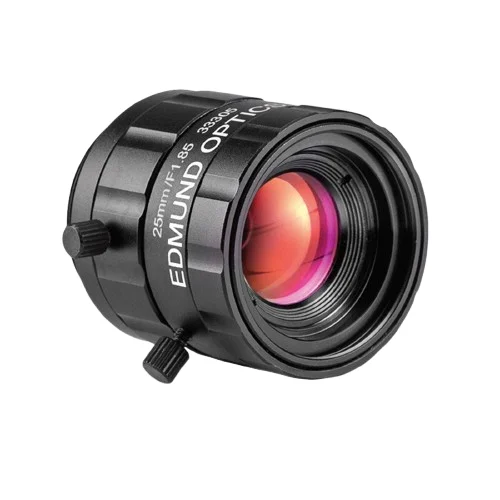
Problem SolvedAttaching machine vision directly to dynamic robotic arms requires lightweight lenses that avoid restricting movement. The lens's highly compact physical profile, proven by a shallow 5.6 mm immersion depth and short 12.7 mm back focal length, minimizes the payload and physical interference on the end-effector. The 25.0 mm focal length provides precise spatial tracking and visual feedback at close distances without getting in the robotic system's physical path.
25.0 mm Focal Length5.6 mm Immersion Depth12.7 mm Back Focal LengthFactory Automation