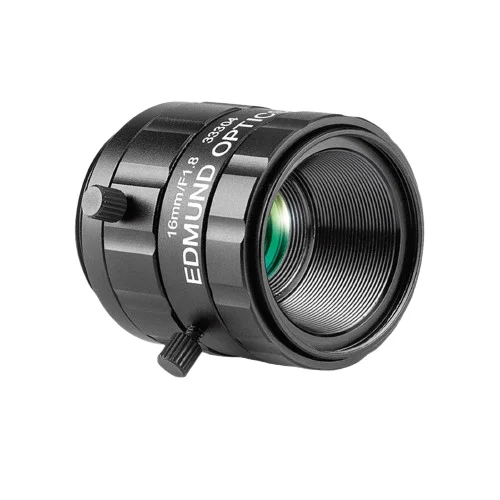
1. Automated Optical Inspection (AOI) for High-Density PCBs
Utilizing the Edmund TECHSPEC UC 16mm lens in confined AOI machinery to perform high-speed, high-resolution inspection of micro-solder joints and miniature surface mount devices (SMD) on printed circuit boards.
Problem SolvedStandard machine vision lenses are often too bulky for ultra-compact AOI machine enclosures. This application solves the spatial restriction while ensuring the system can still resolve microscopic solder defects, justified by the lens's 2.2 µm minimum pixel size and 6.00 MP resolution. The f/1.8 maximum aperture allows sufficient light gathering for the ultra-short exposure times required on fast-moving assembly lines, and the 0.2 m M.O.D. enables close-proximity camera mounting over the conveyor.
2.2 µm minimal pixel size6.00 MP resolutionf/1.8 maximum aperture0.2 m M.O.D.16.0 mm focal length
2. Robotic End-of-Arm Tooling (EOAT) Vision Guidance
Integrating the ultra-compact vision lens directly onto a 6-axis robotic arm's end-effector to provide machine vision guidance for precise pick-and-place operations of small metallic components.
Problem SolvedHeavy and elongated lenses mounted on robotic arms increase the payload and shift the center of gravity, causing vibration and reducing the arm's movement speed in tight factory cells. The lens's short 8.7 mm immersion depth and 9.4 mm back focal length solve this by maintaining a minimal physical footprint and weight. The 22.62° horizontal angle of view paired with the 0.2 m M.O.D. gives the robot the exact field of view needed to recognize part orientation just before actuation.
8.7 mm immersion depth9.4 mm back focal length22.62° Angle of view (H)0.2 m M.O.D.
3. Benchtop Biomedical Microfluidic Diagnostics
Employing the lens inside compact automated medical lab analyzers to monitor cell counts, biological fluid flow, and particulate anomalies within transparent microfluidic chips.
Problem SolvedBenchtop diagnostic devices suffer from highly restricted internal enclosures but require uncompromised edge-to-edge optical clarity to prevent misdiagnosis of biological samples. The 16.0 mm focal length paired with a 1/2" maximum image circle perfectly covers high-resolution 1/1.8" optical class sensors without vignetting. Furthermore, the adjustable f/1.8 - 11 aperture range allows engineers to balance depth-of-field and light intake depending on the varying intensities of the machine's internal LED backlighting.
16.0 mm focal length1/2" maximal image circle1/1.8" optical class compatibilityAperture range (F) 1.8 - 116.00 MP resolution