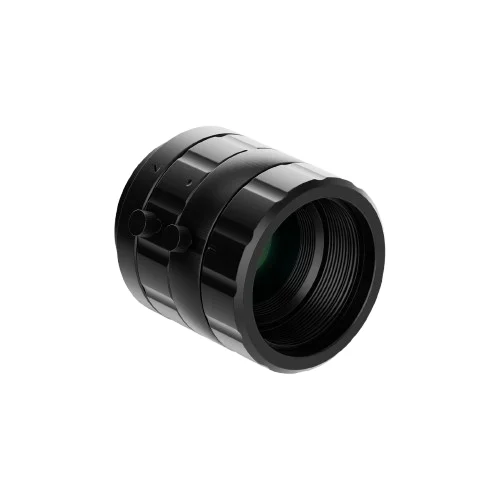
1. Automated Optical Inspection (AOI) for High-Density SMD Printed Circuit Boards
In electronics manufacturing, inspecting densely packed PCBs for minute defects such as solder bridging or missing micro-components (like 01005 packages) requires extremely sharp imaging. Standard vision systems often lack the optical fidelity to distinguish between closely placed metallic traces. Integrating the Edmund Optics AE00218 C-series lens with a high-resolution 2/3" sensor ensures that these microscopic details are captured without distortion at a close inspection range.
Problem SolvedEliminates false passes on PCB inspection lines by capturing micro-defects that lower-resolution setups miss, ensuring high yield and reliability in compact electronics manufacturing.
Resolution 8.40 MPFocal length 25.0 mmMinimal object distance (M.O.D.) 0.10 mMinimal pixel pitch 2.80 µmC-mount
2. High-Speed Pharmaceutical Glass Vial Defect Detection
Pharmaceutical filling lines must continuously monitor clear glass vials for microscopic surface cracks, inclusions, or particulate matter. These lines require precise control of light and depth of field to reveal transparent defects. The lens's flexible aperture allows tuning the depth of field under specialized darkfield illumination, while the 2/3" maximal image circle flawlessly covers industry-standard sensors for unvignetted, edge-to-edge inspection.
Problem SolvedDetects hazardous, hard-to-see hairline fractures and particulates in pharmaceutical glass vials, preventing contaminated or structurally compromised products from reaching end-users.
Aperture range (F) 2 - 11Maximal image circle 2/3"Optical class 2/3"Resolution 8.40 MPAngle of view (H) 19.8°
3. Vision-Guided Robotic Pick-and-Place for Micro-Mechanical Assembly
Automated assembly of micro-mechanical devices, such as luxury watches or miniature medical implants, requires robotic arms to identify and manipulate tiny gears and springs with sub-millimeter precision. The vision system must have a close working distance without physically interfering with the robotic end-effector. The lens's 25mm focal length and short M.O.D. provide the perfect stand-off distance to prevent robotic collisions, while delivering the critical resolving power needed to accurately map part orientations.
Problem SolvedProvides exact spatial coordinates and part orientation to robotic systems handling sub-millimeter components, avoiding physical collisions and preventing damage to highly fragile parts.
Minimal object distance (M.O.D.) 0.10 mFocal length 25.0 mmMinimal pixel pitch 2.80 µmMaximal immersion depth 5.4 mmBack focal length 0.00 mm