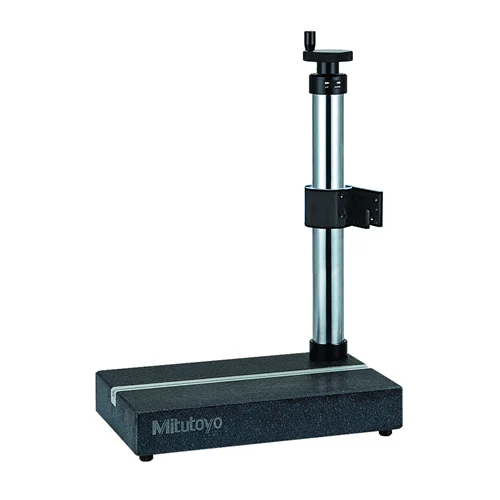
1. Automotive Crankshaft Journal Surface Inspection
In automotive engine manufacturing, the surface roughness of crankshaft journals must be tightly controlled to minimize friction and wear. The Mitutoyo 178-039 manual column stand provides a solid, ultra-stable 20 kg granite base that isolates the Surftest detector from shop-floor vibrations. This allows engineers to conduct highly precise, repeatable sub-micron roughness measurements of large crankshafts, adjusting the 250 mm vertical column height to align the detector with different journal levels.
Problem SolvedLow-frequency production line vibrations and heavy workpiece positioning errors distort micro-roughness measurements, leading to inaccurate quality control. This stand provides the required structural mass and flatness to perform lab-grade measurements near the production line.
surface roughnessmicro-roughnesssub-micron profilingvibration dampingcrankshaft journal
2. Aerospace Turbine Blade Root Geometry Profiling
Aerospace turbine blade roots are machined to extremely tight tolerances with complex geometry. Inspecting the surface roughness of these curved sections requires the Surftest detector to be held in a perfectly rigid, level orientation relative to the blade. By utilizing the 178-039 granite stand's flat lapped surface and 8.5 mm T-slot, operators can mount specialized fixtures to clamp the turbine blades securely, and adjust the column height up to 250 mm for optimal detector engagement.
Problem SolvedClamping and aligning irregularly shaped aerospace components manually leads to stylus misalignment, damage, and inconsistent readings. The granite base's flat surface and T-slot enable precise fixturing, preventing alignment drift.
turbine bladeclamping fixturealignment driftlapped granite baseT-slot mounting
3. Hydraulic Cylinder Bore Quality Control
The internal bore of hydraulic cylinders requires a specific cross-hatch surface pattern to retain oil without causing seal leakage. Assessing this pattern requires inserting the roughness detector's drive unit into the bore at a precise horizontal plane. Using the 178-039 column stand combined with the optional X-axis adjustment unit (178-020), QA technicians can easily level the heavy cylinder workpiece on the granite base, move the column vertically to match the bore centerline, and execute precise linear tracing.
Problem SolvedAligning heavy, cylindrical hydraulic barrels with a delicate surface tester drive unit is challenging. Handheld measurements are impossible. The heavy column stand and granite table support massive workpieces and permit micro-positioning adjustments.
hydraulic cylinderbore inspectionmicro-positioningvertical travelcross-hatch measurement