1. Precision Optical Lens Center Thickness Validation
Used in optical manufacturing plants to verify the central focal thickness of plano-convex and concave glass elements. Quality technicians swap standard flat anvils for the supplied spherical ball contact point to calculate the exact apex or base depth without scratching the anti-reflective coatings.
Problem SolvedStandard flat micrometers cannot reach the absolute center of a curved lens surface due to physical boundary restrictions, introducing large cosine errors. This tool's interchangeable point contacts allow precise localized apex measuring.
Lens MetrologyInterchangeable PointsSpherical Contact PointOptical Inspection
2. Delicate Watchmaking and Micro-Mechanical Component Inspection
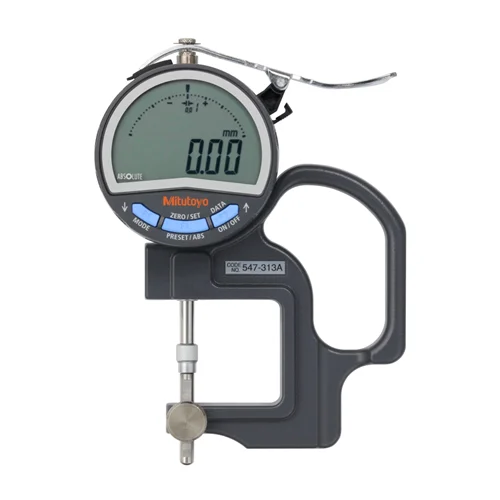
In premium mechanical watch assembly and micro-gear manufacturing, tiny curved plates and delicate brass levers must be inspected to ensure structural precision. The 547-313A's extremely low measuring force (≤ 1.5 N) allows highly repeatable measurements with an accuracy of ±20 µm without risking structural indentation.
Problem SolvedStandard mechanical dial indicators apply high spring-loaded force, which bends, deforms, or marks thin micromachined parts. The low-force spindle of this gauge prevents material stress during check-out.
Micro-MechanicsLow Measuring Force±20 µm AccuracyDeformation Control
3. Automated Quality Control in Optical Film and Battery Separator Extrusion
Used in automated web or roll production testing where continuous plastic samples are slit and measured at multiple intervals. Real-time thickness data is exported through the bidirectional Digimatic S1 interface straight into statistical process control databases (like MeasurLink).
Problem SolvedManual transcription of sequential thickness inspections across moving films creates data errors and slows down line speed. Direct digital SPC communication automates profile-logging with perfect accuracy.
Digimatic S1 InterfaceStatistical Process ControlExtrusion QCAbsolute Encoder