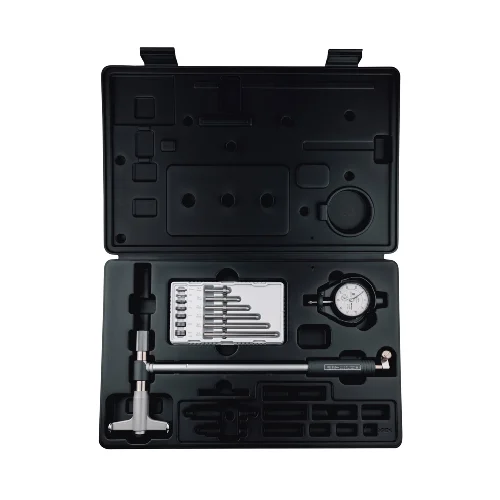
1. Heavy Engine Cylinder Block Reboring Quality Control
Used in diesel engine manufacturing or remanufacturing to verify the final bore diameter of cylinder liners (typically ranging from 160 mm to 250 mm) [1.1.3]. The 250 mm probing depth allows full travel down the bore to check for dimensional consistency.
Problem SolvedDetects cylinder taper and out-of-roundness (ovalness) with 2 µm accuracy, preventing piston slap or premature seal failure due to micro-deviations.
Cylinder BoreTaper MeasurementOut-of-RoundnessEngine Remanufacturing
2. Industrial Hydraulic Cylinder ID Verification
Perfect for inspecting the internal diameter of high-pressure hydraulic cylinders. In systems where piston diameters are between 160 mm and 250 mm, the bore gauge measures the tube's ID at various depths up to 250 mm.
Problem SolvedEnsures the internal bore conforms to precise clearance tolerances (within 2 µm limit), preventing hydraulic fluid bypass under extreme pressures and maintaining seal integrity.
Hydraulic CylinderInside Diameter InspectionTolerancingFluid Power Components
3. Large Heavy-Duty Bearing Housing Inspection
Utilized in rotating machinery maintenance (such as turbines or large pumps) to measure the inside diameter of bearing housings and gearbox bores of 160 mm to 250 mm.
Problem SolvedIdentifies deformation, wear, or misalignment in the bearing seats. The thermal insulation grip reduces operator heat-transfer errors by 50% during long inspections, ensuring the housing remains within specification.
Bearing HousingID MeasurementThermal Isolation GripRotating Machinery Repair