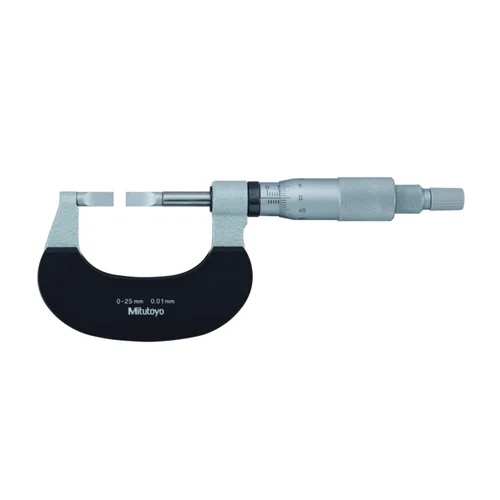
1. Rotary Shaft Retaining Ring Groove Inspection
In electric motor and gearbox assembly, shafts feature narrow machined grooves for circlips or retaining rings. The 0.75 mm Type A blade of the 122-101-10 is thin enough to fit directly into retaining ring grooves as narrow as 1.0 mm, allowing quality control teams to verify the critical root diameter within a 0-25 mm range.
Problem SolvedStandard flat-anvil micrometers cannot physically fit into narrow shaft grooves, while vernier calipers lack the high sub-micron accuracy (±3 µm) and parallelism required to guarantee a uniform groove bottom.
groove diametershaft inspectionretaining ringType A bladeroot diameter
2. Machined Keyway Depth and Bottom Profile Quality Control
During the machining of keyways on drive shafts for coupling torque transmission, ensuring consistent slot depth and bottom thickness is crucial. The non-rotating spindle design of this micrometer prevents the blade anvil from twisting or gouging the keyway slot walls as the measurement is taken.
Problem SolvedStandard rotating spindles cause rotational friction that can mar precision-machined keyway sidewalls and introduce measurement errors due to axial twist or skew.
keyway slotnon-rotating spindledrive shaftsprecision alignmentdamage-free
3. Splined Shaft Pitch Diameter and Root Groove Inspection
In automotive drivetrain manufacturing, splined shafts transfer high torque. Standard micrometers cannot reach the root diameter of splined grooves due to interference with the teeth. The 122-101-10 blade micrometer bypasses the spline peaks, measuring the root diameter directly with a constant force of 3-8 N provided by the ratchet stop.
Problem SolvedEnsures consistent measurement force between different operators to eliminate variance in tight tooth gaps, verifying correct gear matching and preventing drivetrain failures.
splined shaftroot diameterpitch diameterratchet stopconstant force