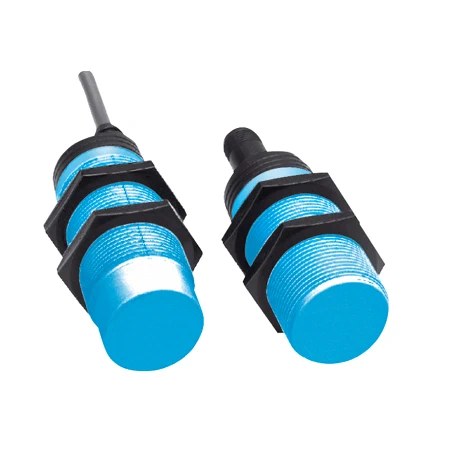
SICK 6028413 CM30-25NAP-KW1 AC Two-Wire Capacitive Sensor

USD 106.86

CM30-25NAP-KW1 offers M30 × 1.5 non-flush capacitive sensing, AC two-wire NC or NO operation, 4–25 mm range and 11-turn sensitivity adjustment.

SKU SICK-6028413 Category
SICK CM

SICK CM30-25NAP-KW1 AC Two-Wire Capacitive Sensor

BrandSICK
Model IdentifierCM30-25NAP-KW1
Official Part Number6028413

Technical Overview

The SICK CM30-25NAP-KW1 is a non-flush-mount capacitive proximity sensor with an M30 × 1.5 threaded housing and AC two-wire NC or NO operation. It detects nearby material through changes in capacitance, supporting qualified metal and nonmetal targets. Its specified sensing range is 4–25 mm, with actual reach dependent on material and installation. The 11-turn sensitivity potentiometer adapts detection sensitivity. The sensor operates from 20–250 V AC at 10 Hz and connects through a 2 m two-wire PVC cable. Its PBT plastic provides IP67 protection according to EN 60529, and two mounting nuts plus a screwdriver are supplied. Material reduction factors guide application setup.

M30 × 1.5 non-flush capacitive sensor with AC two-wire NC or NO operation, 4–25 mm specified sensing range, 11-turn sensitivity potentiometer and 2 m two-wire PVC cable.

Key Features

  • Capacitive proximity detection of qualified metal and nonmetal materials
  • M30 × 1.5 threaded housing for non-flush installation
  • 4–25 mm specified range; material-dependent detection distance
  • Ac two-wire nc or no operation
  • 11-turn sensitivity potentiometer
  • 20–250 V AC supply; 10 Hz switching
  • 2 m two-wire pvc cable
  • IP67 according to EN 60529; PBT plastic
  • Two mounting nuts and one potentiometer screwdriver included

Mount non-flush using the M30 × 1.5 threaded housing and adjust capacitive detection for qualified metal or nonmetal targets with AC two-wire NC or NO operation.

Technical Specification Matrix

ParameterValue
Functional principleCapacitive proximity sensing
Housing designMetric threaded housing
Thread sizeM30 × 1.5
Housing diameter30 mm
Sensing range4–25 mm
Assured sensing distance18 mm
InstallationNon-flush
Switching frequency10 Hz
Electrical wiringAC, 2-wire
Switching outputAc two-wire nc or no
Output functionNC or NO
Adjustment11-turn sensitivity potentiometer
Material reduction factorsReference values, material dependent: metal 1; water 1; PVC approximately 0.4; oil approximately 0.25; glass 0.6; ceramics 0.5; alcohol 0.7; wood 0.2–0.7
Power supply20–250 V AC
Residual ripple≤10% of supply voltage
Current consumption10 mA without load
Initialization time≤100 ms
Hysteresis4–20% of sensing range
Reproducibility≤5% of sensing range at constant supply voltage and ambient temperature
Temperature drift±10% of sensing range
EMCEN 60947-5-2; conducted interference in the oscillator frequency range may change the output signal; observe manufacturer operating instructions
Output current≤500 mA
Connection2 m two-wire pvc cable
Cable materialPVC; do not bend below 0 °C
Conductor cross-section0.5 mm²
Power-up pulse suppressionYes
Shock resistance30 g for 11 ms
Vibration resistance10–55 Hz at 1 mm amplitude
Operating temperature−25 to +80 °C
Housing materialPBT plastic
Housing length75.6 mm
Thread length50 mm
Maximum tightening torque≤7.5 Nm
IP ratingIP67 according to EN 60529
Items suppliedTwo PA12 plastic mounting nuts and one potentiometer screwdriver
IndicatorDisplay LED
MTTFD815 years
Diagnostic coverage DCavg0%
Mission time20 years
Wire assignmentBN: L1; BU: N; AC two-wire load connection as shown in manufacturer CD-013

Industrial Applications

1. Checking a nonmetal part in an assembly fixture

An assembly fixture can place a qualified nonmetal part near the sensing face and use the AC two-wire NC or NO signal to confirm its local presence. The 11-turn sensitivity potentiometer adapts sensitivity to the actual target and surrounding fixture. Commissioning compares empty and occupied states at the installed spacing, taking the documented material reduction factors into account.

Problem Solved

A local presence signal helps the controller detect a missing part before the next assembly step, without requiring a metal target on the component or a contact actuator.

Part presence Nonmetal targets Capacitive sensing

2. Detecting a liquid at a point in a nonmetal vessel

A suitable nonmetal vessel can position the sensor outside its wall at the desired detection point. After testing the actual wall, liquid and spacing, the 11-turn sensitivity potentiometer sets a threshold between empty and filled conditions. The AC two-wire NC or NO output provides a discrete point-level event to a compatible controller; the specified range remains subject to the installed materials.

Problem Solved

A qualified external point-level signal helps the process controller identify liquid reaching the monitored height while avoiding a probe inside the vessel and preserving the vessel wall.

Point level External mounting Qualified vessel wall

3. Monitoring granulate at a feed inspection window

A granulate feeder can place the sensor beside a suitable nonmetal inspection window to check whether material occupies the monitored location. The 11-turn sensitivity potentiometer is set using the actual granulate, window and installation spacing. Empty and filled tests, including expected moisture and buildup conditions, qualify the discrete output before it is used to coordinate feeding.

Problem Solved

A local material-presence event helps the controller identify an empty feed location or arrival of replenishment material, supporting feed sequencing without placing a mechanical paddle in the granulate.

Granulate feed Material presence Threshold setup

Select your currency